

Why High-Rise Structures Must Install Aviation Obstruction Light Systems? — GZ-122 Engineering Application
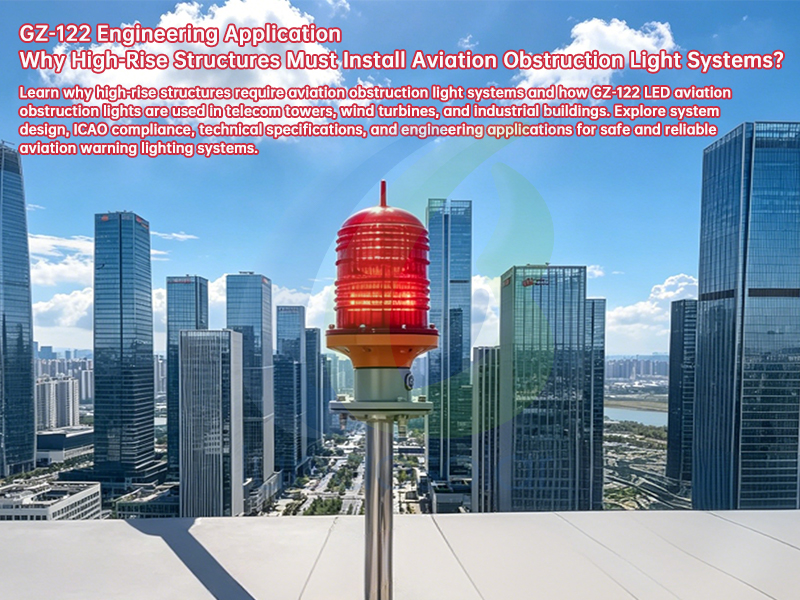
Why High-Rise Structures Must Install Aviation Obstruction Light Systems? — GZ-122 Engineering Application
What Is an Aviation Obstruction Light System?
An aviation obstruction light system is a safety warning lighting solution designed for tall structures. It is widely used on telecom towers, wind turbines, high-rise buildings, and industrial chimneys.
Its primary function is to provide continuous visual warning signals during nighttime or low-visibility conditions, clearly marking structural obstacles and ensuring aviation safety.
Why Must High-Rise Structures Install Aviation Obstruction Lights?
As urban infrastructure continues to expand vertically, tall structures increasingly pose potential collision risks to low-altitude aircraft operations.
According to International Civil Aviation Organization (ICAO) guidelines and civil aviation regulations, structures exceeding specified height thresholds must be equipped with aviation obstruction light systems.
This requirement makes obstruction lighting a mandatory aviation safety compliance measure rather than an optional lighting solution.
How Is an Aviation Obstruction Light System Designed?
Obstruction lighting systems are typically designed based on structural height classification:
- 20–45 meters: Single top-mounted warning light
- 45–150 meters: Top plus mid-level multi-point lighting layout
- 150+ meters: Multi-layer synchronized flashing system with redundancy design
The system is typically integrated with photocell sensors or centralized control units to enable automatic operation and coordinated lighting control.
Role of GZ-122 in the System
The GZ-122 LED aviation obstruction light serves as a standardized node fixture within the system architecture. It is not used as a standalone product but as an execution unit in a distributed obstruction lighting network.
In engineering applications, it is commonly installed at:
- Top of telecom towers as the highest warning point
- Mid-level structural sections for layered visibility
- Multi-tower synchronized lighting systems as network nodes
Its technical configuration is designed to meet system-level operational requirements rather than independent lighting use.
Technical Specifications
| Model | GZ-122 |
| Light Source | High-intensity LED |
| Power | Approx. 20W |
| Light Color | Red / White (optional) |
| Effective Luminous Intensity | 1600 cd (T-074 standard, approx. 6 km visibility range) |
| Protection Rating | IP65 |
| Operating Temperature | -40°C to +60°C |
| Service Life | ≥50,000 hours |
Typical Application Scenarios
- Telecommunication towers
- Wind power generation systems
- High-rise buildings
- Industrial chimneys and transmission towers
- Bridges and large infrastructure structures
Common Engineering Issues
In real-world projects, several issues are frequently observed, including improper height-based lighting layout, unsynchronized multi-light flashing, insufficient protection ratings leading to water ingress, and unstable operation due to lack of control system integration.
These issues are generally caused by incomplete system design rather than individual product quality problems.
Conclusion
An aviation obstruction light system is an essential safety requirement for high-rise structures, ensuring aviation safety and regulatory compliance.
Within the system, the GZ-122 LED aviation obstruction light functions as a standardized node unit, enabling stable and scalable multi-layer warning configurations for telecom, wind energy, and industrial applications.

LED Aviation Obstruction Light Inspection Guide: How Manufacturers Ensure Product Quality
Why Is the GZ-122 LED Aviation Obstruction Light Commonly Used on Towers and Wind Turbines?
Related Article