

Orange or Amber? Why US Road Construction Customers Prefer Amber Warning Lights
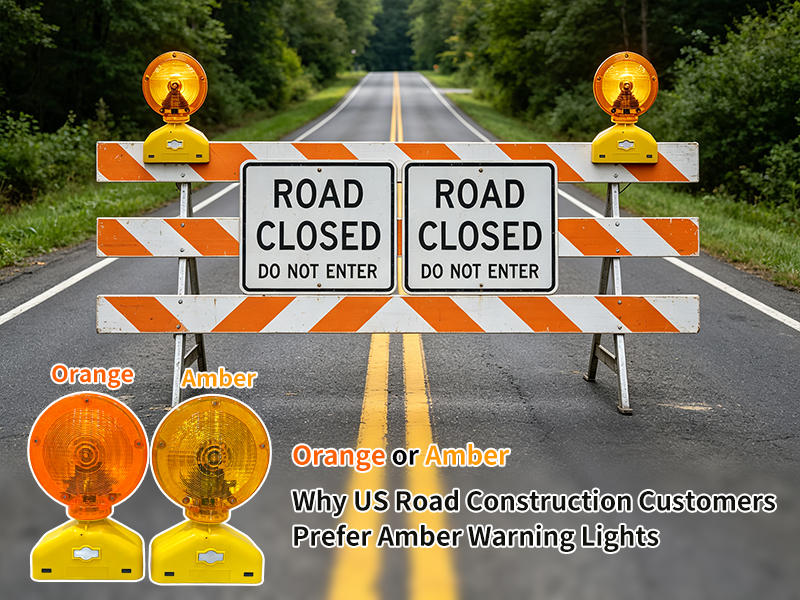
Orange or Amber? Why US Road Construction Customers Prefer Amber Warning Lights
When selecting road construction warning lights, many customers have one common question:
Why do some markets use orange warning lights, while US road construction projects often request amber warning lights?
This is a question we frequently encounter when working with road safety customers in the US market.
The answer is not simply about color preference. It is closely related to the visual communication system, industry practices, and application requirements developed over years in road construction environments.
So, what is the difference between orange and amber, and why has amber become a common choice in US road construction applications?
Orange and Amber: Similar Appearance, Different Functions
Many people assume that orange and amber are simply different names for the same color.
Although they may appear similar, they serve different purposes in road safety applications.
Orange
Orange is widely used for work zone identification, including:
- Construction signs;
- Traffic cones;
- Temporary barriers;
- Roadwork safety equipment.
Its main function is to help drivers quickly recognize a work zone and understand that road conditions may change ahead.
In other words, orange tells drivers:
"There is a work zone ahead."
Amber
Amber is commonly used for active warning devices, such as:
- Warning lights;
- Barricade lights;
- Temporary traffic control equipment.
Unlike passive safety equipment that relies on reflective materials, warning lights use flashing light signals to actively attract drivers’ attention, especially during nighttime operation or poor visibility conditions.
Simply explained:
Orange identifies the work zone, while amber provides an active warning signal.
These two colors are not competitors. They play different roles in a complete road safety system.
Why Are Amber Warning Lights Commonly Used in US Road Construction?
In US road construction, clear and consistent visual communication is a key safety requirement.
The Manual on Uniform Traffic Control Devices (MUTCD) provides guidance for traffic control devices and work zone applications in the United States, helping different safety elements deliver clear information to drivers.
Within a typical US work zone, orange equipment is mainly used to identify the construction area.
For example:
- Work zone signs;
- Traffic cones;
- Temporary channelizing devices.
These elements communicate:
"This area is under construction."
However, identifying the work zone is only one part of road safety.
Drivers also need to recognize:
"Where is an active warning signal?"
During nighttime, rain, fog, or other low-visibility conditions, reflective materials alone may not provide enough visual attention. Warning lights need to actively attract drivers through flashing illumination.
This is why a common combination can be seen in US road construction applications:
Orange work zone equipment + Amber warning lights
Orange helps define the work area, while amber provides an active visual warning.
Over years of application, this combination has become a familiar setup in many US road construction and temporary traffic control projects.
Why Do US Customers Specifically Request Amber Versions?
For US buyers, warning light color is not only a product appearance choice. It is also related to local application experience and project expectations.
In many purchasing projects, customers directly specify:
"Amber version required."
The reason is that contractors, traffic safety suppliers, and project purchasers are already familiar with commonly used configurations in the US market.
Selecting products that match local practices can help:
- Reduce communication during project discussions;
- Improve on-site recognition;
- Maintain consistency with existing safety equipment;
- Better support end-user requirements.
This does not mean orange warning lights cannot be used.
Orange warning lights are also widely applied in road safety projects in many other markets.
The difference is that:
Different regions develop different color preferences based on their own road systems, application environments, and long-term industry practices.
LB-5100US Warning Light: Designed for US Market Applications
This market demand is also reflected in our customer orders.
When US customers purchase LB-5100US Warning Light, they often select the amber version for road construction and temporary traffic control applications.
LB-5100US is suitable for:
- Road construction areas;
- Temporary traffic control;
- Barricades and separation systems;
- Nighttime and low-visibility environments.
With a battery-powered design, the warning light does not require a fixed power supply, allowing quick installation and flexible deployment at different job sites.
Based on different market requirements, LUBAO provides suitable warning light configurations to support various road safety applications.
Choose the Right Warning Light Solution for Your Project
Road safety requirements vary between countries and regions due to differences in regulations, working environments, and purchasing practices.
Whether your project requires amber, orange, or other specified warning light configurations, LUBAO can provide suitable solutions based on your application needs.
If you are looking for reliable LED warning lights for road construction, temporary traffic control, or safety applications, contact us to learn more about our products and solutions.

Why Are Amber Solar Warning Lights Commonly Used? LB-6007 Supports Color and Switch Customization
How to Choose the Right Vehicle LED Warning Light for Work Vehicles and Road Maintenance Vehicles
Related Article