

How Does the Master-Slave Solar Warning Light System Achieve Sequential Power-On Networking and Automatic Switching?
How Does the Master-Slave Solar Warning Light System Achieve Sequential Power-On Networking and Automatic Switching?
System Overview
The master-slave solar warning light system is an intelligent synchronized warning system widely used in road construction, traffic guidance, and safety warning scenarios.
This system is based on a Master-Slave architecture, allowing multiple warning lights to operate under a unified logic and achieve synchronized or sequential flashing effects.
Core objectives: improve safety, reduce configuration cost, enhance coordination stability, and enable automatic fault tolerance.
System Structure
The system consists of two types of devices:
- Master Unit
- Slave Units (up to 20 units per system)
All devices communicate via wireless signals to form an automatic network system.
Master Unit
Responsible for defining flashing patterns, sending synchronization signals, and controlling operation modes.
Slave Units
Responsible for receiving signals, executing synchronized flashing, and maintaining network stability.
👉 This forms a coordinated “control + execution” structure.
Operating Modes
Synchronized Flashing Mode: all lights flash simultaneously to create a unified warning effect.
Sequential Flashing Mode: lights turn on one by one in sequence, creating a flowing visual guidance effect.
All modes are controlled by the master unit, and slave units follow automatically.
Sequential Power-On Automatic Networking (Installation Method)
The system adopts a sequential power-on automatic networking mechanism without manual pairing, but devices must be powered on in sequence.
Why sequential power-on is required?
The system builds its network using a “first powered device becomes the master reference node” logic.
When multiple devices start simultaneously, temporary master competition may occur. Although the system can stabilize automatically, sequential power-on ensures:
- Clear master role assignment
- Avoidance of startup conflicts
- Improved deployment stability
👉 This improves engineering reliability rather than limiting automation.
Deployment process:
- The first unit becomes the reference node
- The second unit joins automatically
- Subsequent units join one by one
- A complete synchronized network is formed
👉 No manual pairing is required, but sequential startup is necessary.
Automatic Master Failover Mechanism
When the master unit fails or loses power:
- The system continues operating
- Slave units switch to independent flashing mode
- A new master is automatically elected
- The system resynchronizes
The original master rejoins as a slave unit once restored.
Slave Signal Loss Handling
When a slave unit loses signal:
- It enters independent flashing mode
- Maintains basic warning function
- Attempts reconnection periodically
- Automatically resynchronizes when signal returns
👉 Single-point failure does not affect the whole system.
Multi-System Anti-Interference Design
In large construction sites, multiple systems may operate simultaneously.
- Approx. 10m communication range (line-of-sight)
- Automatic grouping mechanism
- Built-in signal isolation design
👉 Multiple systems can operate independently without interference.
Battery Performance & Outdoor Durability
Each unit is equipped with a high-capacity rechargeable battery.
- Up to ~1 month operation per full charge
- Actual runtime depends on flashing frequency and sunlight conditions
👉 Suitable for long-term outdoor engineering use.
Comparison With Traditional Systems
| Item | Traditional System | This System |
|---|---|---|
| Pairing | Manual pairing required | Sequential power-on auto networking |
| Master control | Fixed/manual | Automatic election & switching |
| Failure handling | System interruption possible | Automatic recovery |
| Signal loss | May stop working | Independent flashing + auto reconnect |
| Multi-system use | Interference likely | Auto grouping isolation |
| Installation complexity | High | Low |
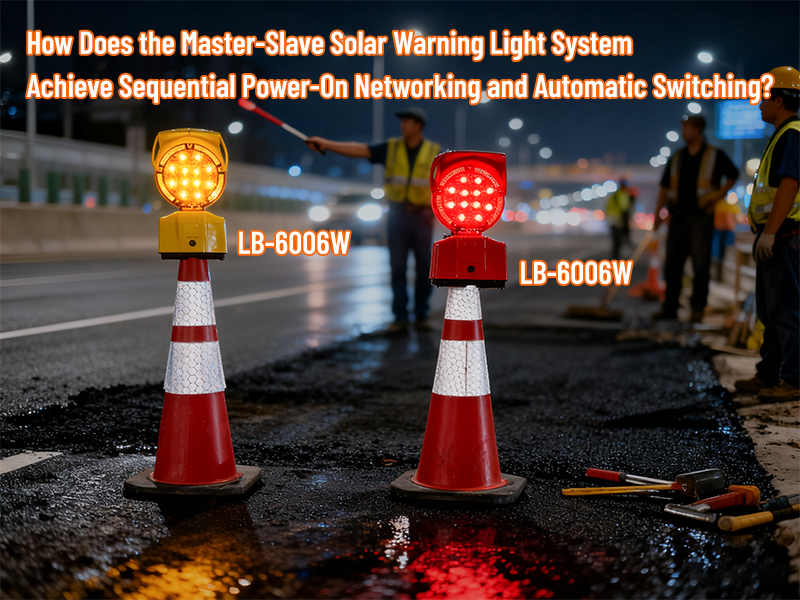
Application: LB-6006W Solar Road Barrier Warning Light
The LB-6006W system is based on master-slave architecture and is widely used in:
- Road construction zones
- Traffic diversion areas
- Temporary road barriers
- Nighttime safety warning applications
Conclusion
The master-slave solar warning light system achieves reliable networking through sequential power-on architecture.
The system supports:
- Automatic master switching
- Signal loss recovery
- Anti-interference operation
- Long-term stable performance
It supports up to 20 units and enables both synchronized and sequential flashing modes.
Contact for Quotation
For pricing, technical specifications, or OEM/ODM support, feel free to contact us.
Real-world project validation is welcome.
Solar Warning Light 2025 Market Analysis Brief: From Scale Expansion to Value Reshaping
How to Ensure Nighttime Construction Safety? How Effective is the LB‑6007 Solar Barricade Light?
Related Article