

Can LED Traffic Signs Really Improve Road Safety?
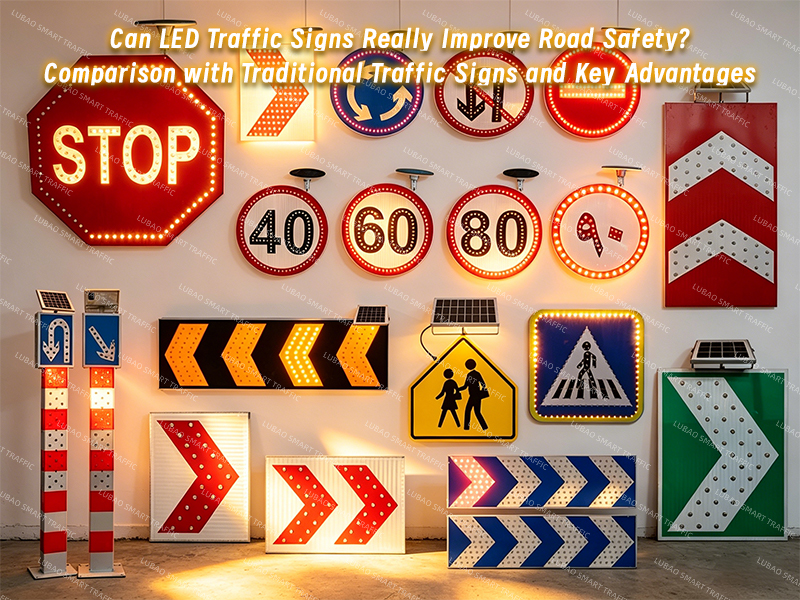
Can LED Traffic Signs Really Improve Road Safety?
Comparison with Traditional Traffic Signs and Key Advantages
Direct Conclusion
LED traffic signs can improve road safety in specific environments by enhancing visibility, recognition distance, and driver reaction time.
However, they are not suitable for all scenarios and do not fully replace traditional reflective traffic signs. Their advantages are mainly concentrated in low-visibility environments, off-grid locations, and high-risk road sections.
Introduction
In road engineering, the core function of traffic signs is effective information delivery. Drivers must be able to clearly recognize sign content from sufficient distance and within limited reaction time, which directly affects driving behavior and accident risk.
Traditional reflective traffic signs are a mature and reliable solution under standard conditions. However, their performance is limited in the following environments:
- Night-time curved roads and highway diverging points without lighting
- Low-visibility weather conditions such as rain, fog, and haze
- Long downhill sections, tunnel entrances, and exits requiring early anticipation
These limitations are determined by the physical nature of passive reflective technology.
Solar-powered LED traffic signs enable independent operation without grid connection.
1. Technical Comparison
1.1 Optical Performance
| Item | Reflective Traffic Signs | Solar LED Traffic Signs |
|---|---|---|
| Light source | Vehicle headlights | Active LED illumination |
| Angle dependency | High | None |
| Night curved roads | Reduced visibility | Stable brightness |
| Rain / fog conditions | Significant reduction | More stable performance |
1.2 Power Supply and Installation
| Item | Reflective Traffic Signs | Solar LED Traffic Signs |
|---|---|---|
| Power supply | None | Self-powered |
| Construction work | Foundation and pole only | Pole + solar system |
| Wiring required | No | No |
| Construction time | Short | Short |
1.3 Maintenance and Service Life
| Item | Reflective Traffic Signs | Solar LED Traffic Signs |
|---|---|---|
| Main aging issue | Reflective film fading | Battery degradation and LED aging |
| Maintenance cycle | 3–5 years | 3–5 years |
| Routine maintenance | Cleaning | Cleaning + inspection |
| Protection rating | Varies | IP65 |
1.4 Application Scenarios
| Scenario | Recommended Solution | Reason |
|---|---|---|
| Urban roads | Reflective signs | Mature and cost-effective |
| Night curved roads | Solar LED signs | Better visibility |
| Remote roads | Solar LED signs | No power infrastructure |
| Rain/fog areas | Solar LED signs | More stable visibility |
| Construction zones | Solar LED signs | Fast deployment |
| Tunnels | Not suitable | No sunlight available |
2. Impact on Road Safety
LED traffic signs improve road safety by enhancing information clarity and recognition efficiency.
- Earlier curve recognition
- Earlier lane diversion recognition
- Stable visibility in bad weather
- Continuous warning in off-grid areas
This mainly improves driver anticipation and decision-making efficiency.
3. Product Solution
Solar LED Traffic Sign System
We provide the following configuration:
- Solar photovoltaic panel
- Energy storage battery system
- Daytime charging, night-time automatic lighting
- Standalone operation without grid connection
Core Features
- High-brightness LED lighting
- Aluminum alloy housing
- IP65 protection rating
- Supports international traffic standards
Customization Capability
- Custom size and structure
- Battery capacity adjustment
- Adaptation to different standards
- Multiple installation methods
Typical Applications
Curve warning, ramp guidance, construction zones, fog areas, mountain roads, and off-grid hazardous road sections.
Conclusion
LED traffic signs are not a replacement for reflective signs, but an important supplement to road safety systems.
Contact
Please contact us for technical details or project solutions.
How to Identify Airport Taxiway Edge Lights at Night
Heliport Lighting System Guide (FAA & ICAO Standards)
Related Article