
How to Choose the Right Housing Material for Solar LED Signs? Differences Between SUS304, SUS316 and SUS316L Stainless Steel
How to Choose the Right Housing Material for Solar LED Signs? Differences Between SUS304, SUS316 and SUS316L Stainless Steel
When purchasing solar LED signs, the housing material is an important factor that affects product cost, service life, and long-term reliability.
Depending on installation environment, application requirements, and project budget, solar LED signs can use different housing materials, including aluminum, galvanized steel, and stainless steel.
Each material has its own advantages in terms of weight, structural strength, corrosion resistance, processing methods, and cost. Therefore, the most suitable material should be selected according to actual project requirements.
Aluminum/aluminum alloy is lightweight and provides good heat dissipation, making it suitable for projects requiring reduced weight or flexible structural design. Galvanized steel offers cost advantages and is suitable for applications where budget control is important.
Stainless steel provides good structural strength and corrosion resistance, making it another commonly used housing option for certain outdoor applications.
Differences Between Common Stainless Steel Materials Used for Solar LED Signs
Although stainless steel offers good corrosion resistance, different stainless steel grades have different performance characteristics and application environments.
Many buyers know that stainless steel is suitable for outdoor use, but they may not fully understand the differences between SUS304, SUS316, and SUS316L.
These stainless steel grades differ in corrosion resistance, application conditions, welding performance, and cost. A higher grade does not always mean it is the best choice for every project.
Therefore, selecting stainless steel housing requires considering installation conditions, expected service life, and project budget.
SUS304 Stainless Steel: A Balanced Choice Between Performance and Cost
SUS304 is one of the most commonly used stainless steel materials for solar LED sign housings.
It provides good corrosion resistance and mature processing technology, achieving a good balance between performance and cost.
For common outdoor applications such as city roads, parking areas, residential roads, and standard highway projects, SUS304 is usually sufficient for long-term use.
Due to its reasonable cost, SUS304 is also widely used in large-volume projects.
However, in coastal areas, ports, or high salt spray environments, chloride ions and moisture may accelerate corrosion. For these conditions, stainless steel with higher corrosion resistance, such as SUS316, may be more suitable.
SUS316 Stainless Steel: A Better Choice for High-Corrosion Environments
SUS316 is an upgraded option based on SUS304.
With the addition of molybdenum, SUS316 provides stronger resistance against chloride corrosion compared with SUS304, making it suitable for:
- Coastal roads;
- Port areas;
- Island locations;
- High-humidity environments.
For solar LED sign projects, the main advantage of SUS316 is its improved long-term corrosion resistance in harsh outdoor conditions.
Although SUS316 has a higher cost than SUS304, it can help reduce maintenance and replacement risks for projects where access is difficult, such as highways, remote areas, and large infrastructure projects.
SUS316L Stainless Steel: A Reliable Solution for High-Requirement Projects
SUS316L is the low-carbon version of SUS316.
Its main advantage is improved welding stability. During solar LED sign manufacturing, housings, brackets, and connection structures usually require welding, and welded areas may become more vulnerable in corrosive environments.
Due to its lower carbon content, SUS316L helps reduce corrosion risks in welding areas and improves overall structural reliability.
It is more suitable for:
- Marine environment projects;
- High salt spray areas;
- Long-term infrastructure projects;
- Applications requiring extended service life.
How to Choose Between SUS304, SUS316, and SUS316L?
Choosing the right stainless steel grade is not about selecting the highest grade, but about matching the material with the actual application.
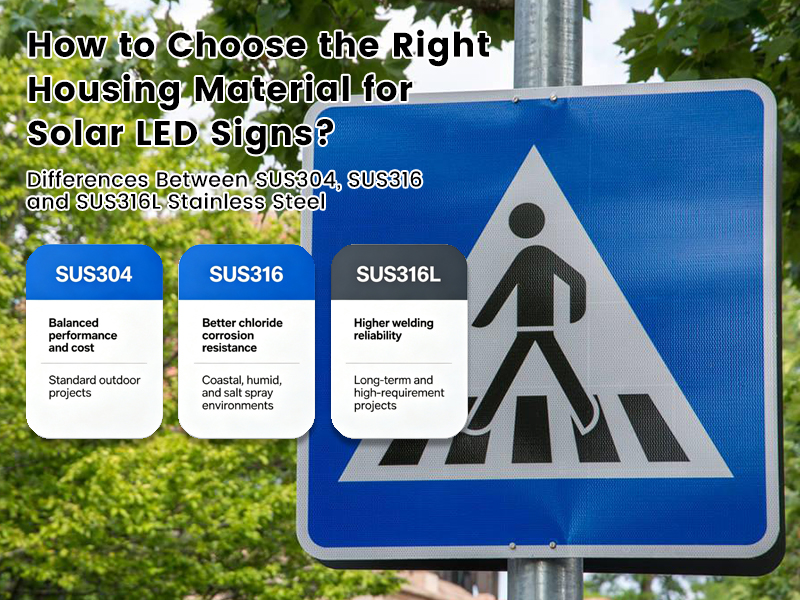
| Material | Main Features | Suitable Applications |
|---|---|---|
| SUS304 | Balanced performance and cost | Standard outdoor projects |
| SUS316 | Better chloride corrosion resistance | Coastal, humid, and salt spray environments |
| SUS316L | Higher welding reliability | Long-term and high-requirement projects |
Before making a decision, buyers should consider:
- Installation location;
- Climate conditions;
- Product size and structure;
- Expected service life;
- Maintenance difficulty;
- Project budget.
The best solution is to balance reliability, cost, and long-term value.
How We Help Customers Choose the Right Material
Different projects have different requirements for solar LED sign housings. Choosing the right material is more important than simply selecting the highest stainless steel grade.
As a professional solar LED sign manufacturer, we provide material recommendations and customized production solutions based on:
- Installation environment;
- Product structure requirements;
- Expected service life;
- Project budget.
Whether using SUS304, SUS316, SUS316L stainless steel, aluminum, or galvanized steel, we help customers select a suitable housing solution according to their actual application needs.
If you are planning a solar LED sign project, please share your installation environment and product requirements. Our engineering team can recommend a suitable housing material solution and provide professional support.
How Do You Install Red Green LED Road Studs for Smart Crosswalks?
What Should Buyers Check Before Shipment When Purchasing LED Traffic Batons?丨lu-bao.com
Related Article