
Solar Warning Light 2025 Market Analysis Brief: From Scale Expansion to Value Reshaping
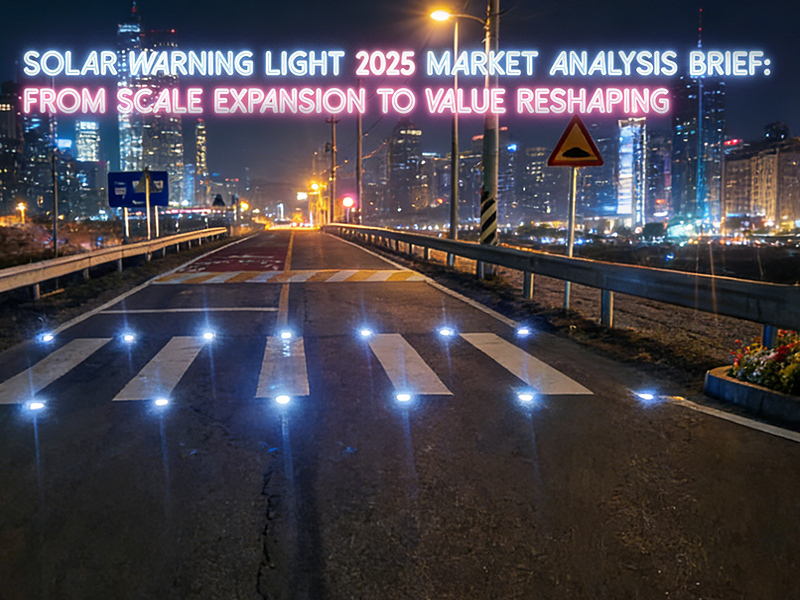
Solar Warning Light 2025 Market Analysis Brief: From Scale Expansion to Value Reshaping
1. 2025 Market Fundamentals
The global solar warning light market is estimated to exceed $520 million in sales in 2025, representing a year-on-year increase of approximately 9.3%. North America, Europe, and the Middle East contribute the majority of value share, while Asia-Pacific and Latin America are driven by shipment volume.
The market shows a clear "dual-track" structure:
Professional engineering grade: Aviation obstruction lights, power tower warning lights, etc. Constrained by ICAO, FAA and other standards, reliability tolerance is extremely low, with high brand premiums.
Temporary work zone grade: Barrier lights, traffic cone lights, construction guidance lights. These account for over 60% of total shipments, are extremely price-sensitive, and are the primary source of quality complaints.
Regional demand variations are significant: North America and Europe require certification and high unit prices; the Middle East and Africa prioritize high-temperature resistance and basic models; emerging Asia-Pacific markets focus on low price.
| Region | Demand Characteristics | Core Requirements |
|---|---|---|
| North America, Europe | Government & large projects | Wireless sync, UL/CE certification, high price |
| Middle East, Africa | Insufficient grid, high temperature & dust | Heat resistance, dustproof, basic models |
| Mature Asia-Pacific (Japan, Australia) | Aligns with EU/US standards | Long lifespan, integrated design |
| Emerging Asia-Pacific | High volume, low price | Price priority, flexible certification |
⚠️ Channel Alert: Return rates for this category on major cross-border e-commerce platforms reach 15%-25%, primarily due to "insufficient battery life" and "rapid brightness degradation." Low-cost cross-border models are putting pressure on industry credibility.
🔋 Key Judgment: LiFePO₄ batteries are already common in mid-to-high-end products in Europe and the US, but have not yet trickled down to barrier lights or high-volume products in emerging markets due to cost. The technology gap will be difficult to close in the short term.
2. International Certification Systems: The Critical Market Access Gateway
For export-oriented companies, international certification is the "pass" to high-value markets. Certification requirements vary significantly across target markets, and the barriers are generally rising.
Aviation safety: Aviation obstruction lights must meet ICAO Annex 14 or FAA AC 70/7460-1K standards. FAA L-810 (low intensity) and L-864 (medium intensity) are mainstream models internationally.
General lighting and barrier lights:
EU market: CE certification is mandatory, including LVD (electrical safety), EMC (electromagnetic compatibility), RoHS (hazardous substance restrictions), etc. If wireless synchronization is included, RED directive RF certification is required.
US market: FCC certification (EMC) is mandatory; wireless functions require FCC ID. UL certification (safety) is commonly required for large procurements, with UL 1598 (fixed) or UL 1573 (portable) depending on product type.
Australian market: SAA certification (electrical safety) is mandatory; CEC listing affects PV component subsidy eligibility.
Certification value: Products with UL or CE certification can command prices 30%-50% higher than uncertified products. Government projects and large engineering procurements in Europe and the US generally list certification as a mandatory qualification.
3. Key Quality Concerns for Buyers
| Dimension | Common Issue | Buyer Verification Points |
|---|---|---|
| Actual battery life | Claims 72 hours,实测 under 24 hours实测 | Request third-party test reports; confirm battery type (LiFePO₄ > lead-acid); ask about performance below -20°C |
| Housing durability | Cracking, water ingress within 3-6 months | Confirm UV-resistant polycarbonate material; IP rating must be certified (IP54 for e-commerce/general, IP65+ for engineering projects) |
| Synchronization reliability | Loss of sync, entire group failure when multiple lights are mixed | Require on-site testing with 10+ units placed together for 24 hours; prioritize Sub-1G/LoRa; for 2.4G, confirm frequency hopping design |
| Certification compliance | Unable to bid/clear customs without certification | CE for EU, FCC+UL for US, ICAO/FAA for aviation; require valid certificates and test reports |
4. Main Application Scenarios
| Scenario | Typical Requirements | Major Markets | Key Metrics |
|---|---|---|---|
| Aviation safety (low-altitude economy) | Medium/high intensity obstruction lights, GPS sync | North America, Europe | ICAO/FAA certification, -40~70°C |
| Grid anti-breakage | Solar warning light: red/blue strobe, 300m+ visibility | Australia, Brazil | Weather resistance, bidirectional warning |
| Road maintenance & temporary work zones | Barrier/cone light: magnetic+hook, one-key sync | Europe, North America | IP rating, certification |
| Rural roads / off-grid areas | Solar yellow flashing warning light | Africa, Southeast Asia | Low cost, basic protection |
5. Form Factor & Technology Trends
5.1 Permanent Installation (Aviation Obstruction Lights, Fixed Solar Road Studs, Power Tower Warning Lights)
Integrated circular/oval design with PV panel/battery/light source highly integrated
Wireless synchronization (LoRa/2.4G) has become standard for engineering projects in developed countries
Monocrystalline silicon fully replaces polycrystalline silicon; MPPT controller is standard in mid-to-high-end models
Some models add 12V DC charging backup or NFC mobile phone parameter adjustment
5.2 Temporary Work Zone (Barrier Lights, Cone Lights, Construction Guidance Lights)
Mounting: Supports magnetic, hook, clip-on and other quick-attach structures,适配 cones, barriers, water-filled barriers, etc.
Warning colors: Red/blue dual-color strobe is mainstream; some models support red/yellow switching
Ingress protection: IP54 is baseline for e-commerce high-volume models; IP65+ for engineering projects
Materials: UV-resistant polycarbonate commonly used for exports to Europe and the US
Feature expansion: Some mid-to-high-end models support wireless synchronization
5.3 Wireless Synchronization Technology Comparison
| Technology | Advantages | Disadvantages | Applicable Scenarios |
|---|---|---|---|
| 2.4G | Low cost, mature chips | Susceptible to interference, possible loss of sync with many lights | ≤20 units, general construction |
| Sub-1G | Good penetration, less interference, long range | Slightly more expensive, frequency band switching required | 50+ units, complex environments |
| LoRa | Ultra-long range, low power, strong anti-interference | Higher cost | Large construction zones, smart transportation |
| GPS/BeiDou | Nanosecond-level synchronization accuracy, global coverage | High cost, requires clear sky view | Aviation obstruction lights, marine warning |
6. 2026 Core Trends
| Trend | Core Change | Affected Regions | Timeline |
|---|---|---|---|
| Standard tightening | FAA/ICAO update battery & luminous decay requirements; EU to quantify barrier light metrics | North America, Europe | 2026-2027 |
| Certification upgrades | Emerging markets introduce local certification (Chile, Pakistan, Colombia, etc.) | Latin America, South Asia | Effective from 2026 onward |
| PV + sensing | Integration of vibration/light sensors, LoRaWAN gateway | North America, Europe | Accelerating from 2026 |
| Rental-as-a-service | Subscription model, supplier responsible for full lifecycle | Europe → North America, Australia | Already validated in Europe |
| Information transparency | Labeling of actual battery life, battery cycle count | Cross-border e-commerce | Platforms increasing random inspections |
Standard tightening: FAA and ICAO will update aviation obstruction light certification requirements in 2026; the EU plans to introduce quantitative metrics for barrier lights. Low-end products will face stricter procurement thresholds. LiFePO₄ + BMS has become a common configuration for mid-to-high-end export products.
Certification upgrades: Emerging markets are successively launching local certification or pre-shipment inspection requirements. Export enterprises need to prepare compliance documents in advance.
PV + sensing: Actively enhanced barrier lights can感应 vehicle headlights or ground vibrations, automatically adjusting brightness and flashing patterns. High-end products can integrate traffic counting and environmental sensing, becoming smart city nodes.
Rental-as-a-service: Major European rental companies have shifted to subscription models, where the supplier is responsible for charging, maintenance, and end-of-life recycling. Expected to expand to North America and Australia in 2026.
Information transparency: Compliant brands will more proactively label equivalent lumens, actual battery life, battery cycle count, and operating temperature. The reference weight of third-party test reports is expected to increase.
Road Barricade Lights 2025-2026: What Certifications, Quality Factors, and Trends Matter?
How Does the Master-Slave Solar Warning Light System Achieve Sequential Power-On Networking and Automatic Switching?
Related Article