

Curves, Ramps, and Work Zones: Where Should Yellow Flashing Lights Be Installed?
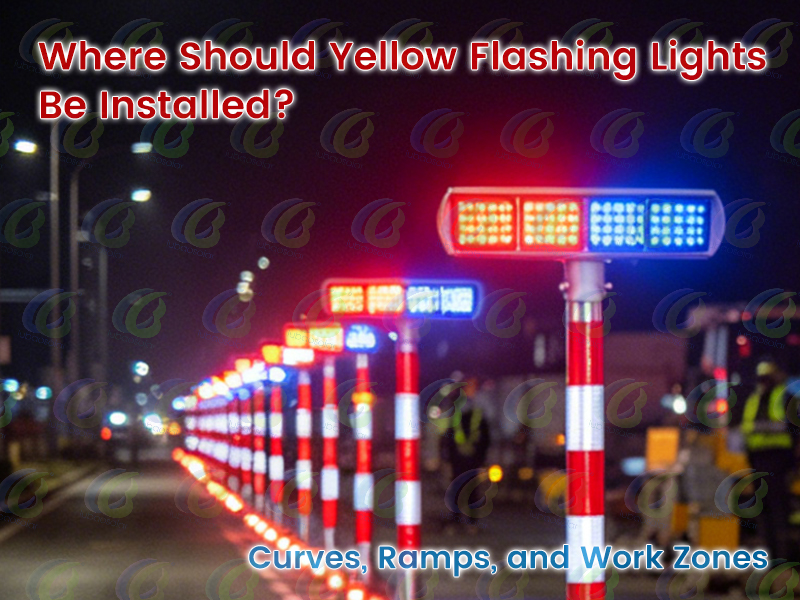
Curves, Ramps, and Work Zones: Where Should Yellow Flashing Lights Be Installed?
1. Why Do Highways Need Yellow Flashing Lights?
Highway speeds are high, leaving drivers with very little reaction time. In work zones, ramps, and curved sections, inadequate visibility distance is a leading cause of accidents.
Without active luminous warning devices, drivers can only rely on reflective cones to judge work zone boundaries. The effective visibility distance is often less than 100 meters. A solar yellow flashing light creates a continuously identifiable warning point at a long distance, buying time for deceleration and lane changes.
This need is universal in highway operations around the world. Although technical standards vary by country, the core performance requirements for yellow flashing lights are consistent.
2. Four Basic Requirements for a Highway-Grade Yellow Flashing Light
Not all yellow flashing lights are suitable for highways. Based on road environment characteristics and visual ergonomics, a truly suitable solar yellow flashing light must meet the following four requirements.
2.1 Lens Diameter ≥ 300mm
Lens diameter directly determines visibility distance. According to research by the International Commission on Illumination (CIE), the effective visibility distance of a 100mm warning light on a highway is only 60–80 meters. At a speed of 120km/h (about 33m/s), the distance required from recognition to braking is approximately 200 meters. Therefore, the lens diameter should be at least 200mm. 300mm is the mainstream choice in the international market.
2.2 Flashing Frequency: 40–60 Flashes Per Minute
Human sensitivity to flashing light has an optimal range. Standards vary slightly by country and region:
| Standard | Flashing Frequency Requirement |
|---|---|
| U.S. MUTCD | 50–60 FPM |
| Europe EN 12352 | 60–120 FPM (low end recommended) |
| China GB/T 24965 | 40–60 FPM |
Overall, 40–60 FPM is a widely accepted safe range. Too low a frequency (e.g., 30 FPM) may cause drivers to miss the signal when the light is off. Too high a frequency (e.g., above 120 FPM) can produce a "fusion effect," making multiple flashing lights appear steady and losing their warning function.
2.3 Battery: LiFePO₄ with ≥ 60 Days Autonomy
Highway work zones typically have no access to external power. Solar yellow flashing lights must operate independently on battery power.
Lithium iron phosphate (LiFePO₄) offers clear advantages: cycle life exceeding 2,000 cycles (4–5 times that of lead-acid batteries), high thermal stability suitable for outdoor exposure, and heavy metal-free composition compliant with EU RoHS requirements. Under continuous overcast or rainy conditions, the device should maintain operation for 60 days without failure, covering typical work zone durations.
2.4 Light Color: Yellow
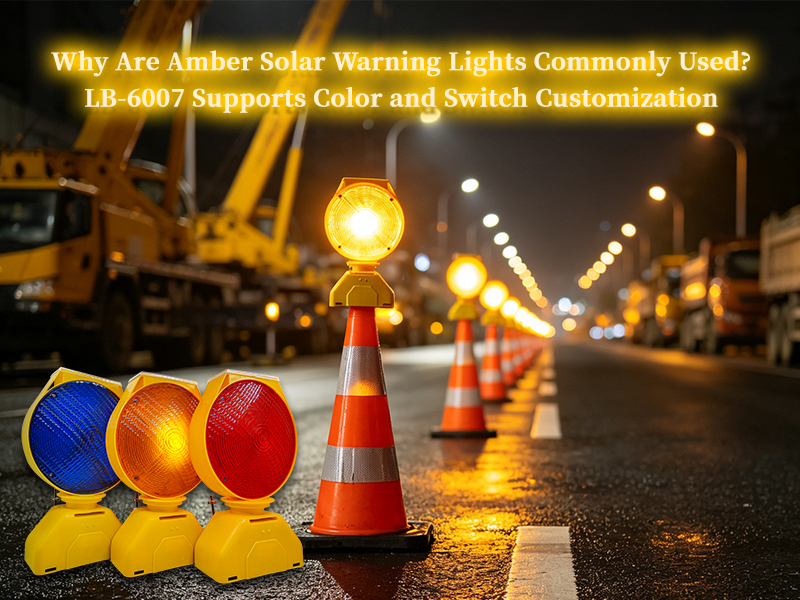
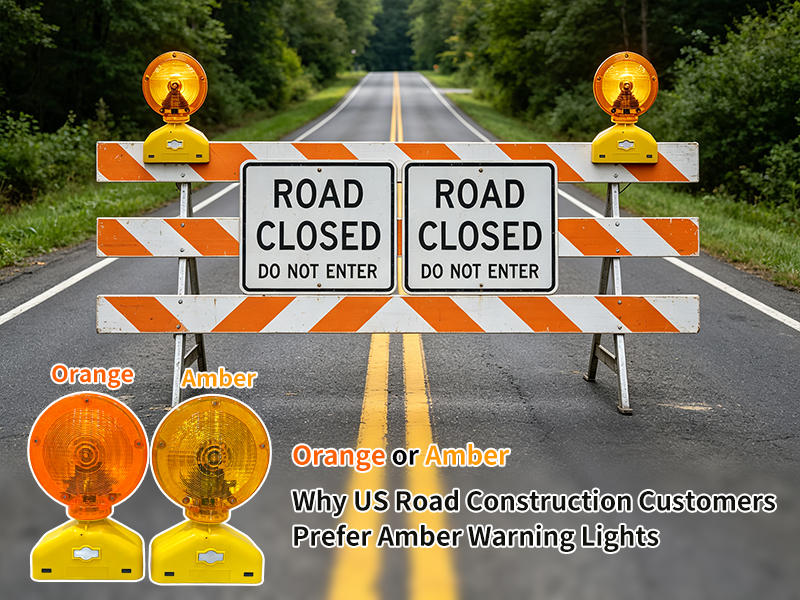
Yellow (amber) represents "caution, warning, slow down" in most countries' traffic systems, aligning with driver expectations. Additionally, yellow light has strong penetration, providing longer visibility distance in rain and fog.
3. Product Specifications: LB-L19 Solar Yellow Flashing Light
The specifications of the LB-L19 solar yellow flashing light are as follows:
| Parameter | Specification |
|---|---|
| Model | LB-L19 |
| Lens Diameter | 300mm |
| Visor Extension | 256mm |
| Flashing Frequency | Configurable, 40–60 FPM typical |
| Battery | 12V 10Ah LiFePO₄ |
| Autonomy | 60 days (without solar charging) |
| Light Source | Yellow LED, 125 pcs (5mm) |
| Solar Panel | 18V 10W |
| Housing Material | Polycarbonate (PC), yellow backplate aluminum |
| Installation | Ready to use, no external power connection required |
Key features of the LB-L19:
- 300mm lens: Visibility distance of 200–250 meters
- LiFePO₄ battery: 60-day autonomy, 2,000-cycle life
- 40–60 FPM flashing frequency: Compatible with MUTCD, EN 12352, GB/T 24965
- Plug-and-play: Suitable for rapid deployment scenarios
4. Why Should Spacing Be Reduced on Curves?
This is a geometric issue, not a matter of experience.
On straight sections, driver vision is unobstructed. A warning light 200 meters away is clearly visible. But curves limit sight distance significantly.
Take a curve with a 500-meter radius as an example: when a vehicle travels on the outside of the curve, the visible length of the shoulder ahead is only 80–100 meters. If yellow flashing lights are spaced every 100 meters based on straight-section experience, blind spots will appear on the curve.
Conclusion: Spacing on curves should be reduced to 30–50 meters, approximately half of straight-section spacing. This principle is reflected in road engineering standards worldwide.
5. Three Locations Where Yellow Flashing Lights Must Be Installed
| Location | Installation Parameters | Reasoning |
|---|---|---|
| Upstream of Work Zones | Range: 500–1,000m upstream Spacing: 50–100m Quantity: ≥3 units |
At 120km/h, braking distance is approx. 200m. A 500–1,000m range provides 3–5 warning signals, gradually building distance perception. Fewer than 3 units breaks the warning sequence, risking misjudgment. |
| Outside of Small-Radius Curves | Range: From 100m before curve Spacing: 30–50m Height: 0.8–1.2m above ground |
Curve curvature limits sight distance. On a 500m radius curve, visible guardrail length is only 80–100m, requiring spacing of 30–50m to ensure at least one light is always visible. Mounting height aligns with driver eye level, avoiding obstruction or placement above the line of sight. |
| Ramp Diverging Points | Location: Below exit sign or at diverge island nose Quantity: ≥1 per exit; 2–3 for large interchanges |
Exit areas require drivers to identify, change lanes, and decelerate quickly. The diverge island nose is the last fixed reference point before divergence. Large interchanges have dense exits, requiring additional units to avoid confusion between exits. |
6. Summary
The selection and placement of yellow flashing lights directly affect work zone safety levels.
The LB-L19 solar yellow flashing light meets or exceeds industry requirements on all key indicators: lens diameter, flashing frequency, battery autonomy, and light color. It is suitable for work zones, curves, and ramps on most highways worldwide.
For detailed technical documentation or deployment proposals for specific road sections, please contact us.
How Do LED Road Flares Work? 10 Modes & Usage Scenarios Explained
Road Barricade Lights 2025-2026: What Certifications, Quality Factors, and Trends Matter?
Related Article