
What Is an Airport Wind Sock? How to Choose an Illuminated Wind Indicator
What Is an Airport Wind Sock? How to Choose an Illuminated Wind Indicator
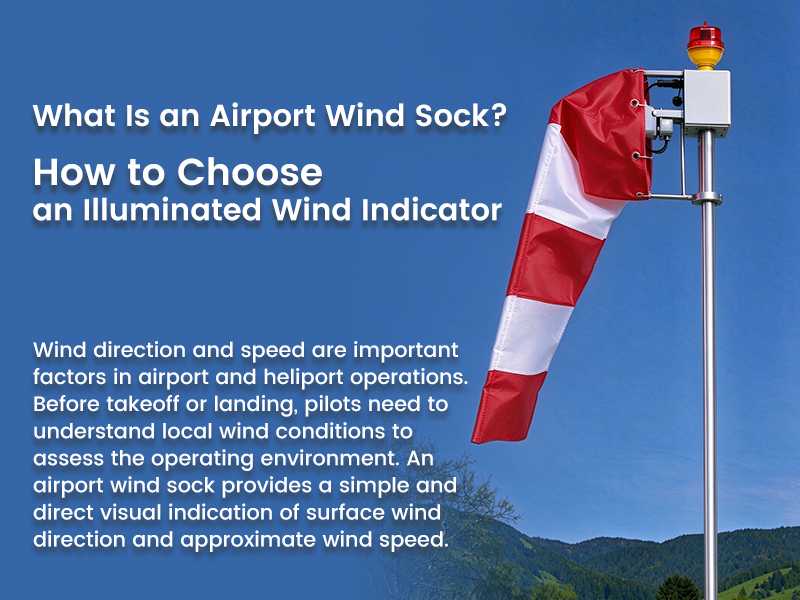
Wind direction and speed are important factors in airport and heliport operations. Before takeoff or landing, pilots need to understand local wind conditions to assess the operating environment. An airport wind sock provides a simple and direct visual indication of surface wind direction and approximate wind speed.
However, visibility can become a challenge at night or in low-light conditions. This is why many airports and heliports use an illuminated wind indicator to make the windsock easier to see after dark.
When selecting an airport wind cone, it is important to consider more than its size and appearance. Lighting configuration, power supply, structural materials, installation conditions, and environmental resistance all play a role in choosing the right equipment.
In this article, we explain how airport windsocks work, why lighting matters, which power supply options are available, and what to consider when selecting an airport windsock with light. We will also introduce the LB-ZH-802 Airport Wind Sock manufactured by LUBAO SMART TRAFFIC CO., LIMITED.
Table of Contents
- 1. What Is an Airport Wind Sock?
- 2. How Does a Windsock Indicate Wind Direction and Speed?
- 3. Why Do Airports Need Illuminated Windsocks?
- 4. What Power Supply Options Are Available?
- 5. Materials and Structure of Airport Wind Cones
- 6. LB-ZH-802 Airport Wind Sock Specifications
- 7. Where Are Airport Windsocks Used?
- 8. How to Choose the Right Airport Wind Sock
- 9. Why Choose LUBAO?
- 10. Contact Us
1. What Is an Airport Wind Sock?
An airport wind sock, also known as an airport wind cone or wind direction indicator, is a visual device installed at airports and heliports to show local wind direction and provide an approximate indication of wind speed.
Unlike electronic weather instruments that display numerical readings, a windsock uses the movement of a fabric sleeve to communicate wind conditions. It rotates freely with the wind, allowing pilots and ground personnel to observe changes in wind direction and the degree to which the fabric is extended.
A typical airport wind cone assembly consists of several main components:
- Windsock: A tapered fabric sleeve that responds to changes in wind conditions.
- Rotating frame: Allows the windsock to turn freely according to wind direction.
- Support pole: Holds the windsock and associated lighting equipment.
- Lighting system: Illuminates the windsock for nighttime visibility.
- Mounting base: Secures the assembly to the installation foundation.
- Optional obstruction light: Helps identify the support structure as an aviation obstacle where required.
Although its structure is relatively simple, an airport wind sock plays an important role in providing visual wind information. Its dimensions, visibility, installation position, and lighting configuration should all be considered during project planning.
2. How Does a Windsock Indicate Wind Direction and Speed?
Understanding how a windsock works makes it easier to select the right wind direction indicator for an airport or heliport project. Its main function is based on two visual signals: the direction in which the fabric points and how far it extends.
Wind Direction
Air enters through the wider opening of the windsock and flows toward the smaller end. As a result, the fabric extends in the direction the wind is blowing toward.
For example, if a windsock points east, the wind is generally coming from the west. This allows pilots to identify the prevailing surface wind direction at the installation location.
Approximate Wind Speed
The extension of the windsock also provides a visual indication of wind strength.
- Fully extended: Generally indicates stronger wind.
- Partially extended: Indicates moderate or lighter wind conditions.
- Hanging downward: Usually indicates very light wind or calm conditions.
A windsock provides a quick visual reference rather than an exact wind speed measurement. When accurate wind speed data is required, it should be used together with professional meteorological instruments.
3. Why Do Airports Need Illuminated Windsocks?
During daylight hours, the bright colors of a windsock generally make it easy to identify. At night, however, reduced natural light can make the fabric difficult to see.
For airports and heliports that operate after dark, an illuminated wind indicator helps maintain the visibility of the windsock. By providing suitable illumination, pilots can more easily observe its position and movement under low-light conditions.
Windsock Lighting vs. Aviation Obstruction Lights
These two lighting systems are sometimes confused when selecting an airport windsock with light. However, they serve different purposes.
1. Windsock Lighting
Windsock lighting is designed to illuminate the fabric sleeve so that its direction and extension can be observed at night. Depending on the product design, illumination may be provided by internal lighting or external floodlights.
2. Aviation Obstruction Light
An aviation obstruction light is used to mark a structure that may present an aviation obstacle. It helps pilots identify the structure at night or in reduced visibility conditions. Its purpose is different from that of a windsock illumination light.
Therefore, an obstruction light should not be considered a replacement for windsock lighting.
For the LB-ZH-802, the top lighting configuration can be selected according to project requirements. The obstruction light can be installed, omitted, or replaced with an illumination light. The specific lighting arrangement should be confirmed before ordering.
4. What Power Supply Options Are Available for Airport Windsocks?
The power supply is another important factor when selecting an illuminated airport wind cone. The right option depends on the availability of electricity at the installation site, operating requirements, and the selected lighting configuration.
AC 220V Power Supply
AC 220V is suitable for installations where a stable mains power supply is available. It is a practical option for airports and fixed facilities with existing electrical infrastructure.
Before installation, the input voltage of the lighting equipment should be checked against the available power supply.
DC 12V Power Supply
DC 12V is suitable for projects that use a low-voltage DC power system. It can be considered when the installation site already has a compatible DC power source.
Solar Power Supply
For remote locations or sites where running electrical cables is difficult, a solar-powered airport windsock can be an alternative.
A solar power system generally consists of a solar panel and a rechargeable battery. It reduces dependence on the local electricity grid and provides greater flexibility for installations without convenient access to mains power.
However, solar system sizing should not be based on power consumption alone. Local sunlight conditions, daily operating hours, battery capacity, and the number of consecutive cloudy days should all be considered.
The LB-ZH-802 supports three power supply options: AC 220V, DC 12V, and solar power. The appropriate configuration can be selected according to the project requirements. Solar panel and battery specifications should be confirmed separately.
5. Materials and Structure of Airport Wind Cones
An airport wind cone is normally installed outdoors and exposed to sunlight, rain, changing temperatures, and wind loads. Therefore, the materials and structural design are important considerations for long-term outdoor use.
Stainless Steel Support Structure
Stainless steel offers good corrosion resistance and is commonly used for outdoor support structures. Selecting suitable stainless steel helps reduce corrosion concerns during long-term outdoor installation.
Waterproof Fabric Windsock
The windsock is usually made from lightweight fabric that can respond to changing wind conditions. Waterproof fabric is suitable for outdoor environments where the equipment is exposed to rain and moisture.
Red and white alternating sections improve visual contrast and make the windsock easier to identify against different backgrounds.
Rotating Mechanism and Mounting Base
The rotating mechanism allows the windsock to follow changes in wind direction. It should operate smoothly without restricting the natural movement of the fabric sleeve.
The mounting base also needs to match the site foundation and installation requirements. A suitable mounting arrangement helps keep the complete assembly securely installed.
Protection Rating and Operating Environment
Since illuminated windsocks contain electrical components, their protection rating and operating temperature range should be checked before purchase.
For example, the LB-ZH-802 features an IP65 protection rating and an operating temperature range of -40°C to +70°C. These specifications help buyers evaluate whether the equipment is suitable for their intended outdoor environment.
6. LB-ZH-802 Airport Wind Sock Specifications
To meet different airport and heliport project requirements, LUBAO SMART TRAFFIC CO., LIMITED offers the LB-ZH-802 airport wind sock.
The product features a stainless steel support structure and a waterproof fabric windsock. It has an overall height of 2.5 meters and a 1.5-meter windsock with five alternating red and white sections, starting with red.
The LB-ZH-802 supports AC 220V, DC 12V, and solar power options. Its top lighting configuration can also be adjusted according to project requirements, making it possible to select an obstruction light, a windsock illumination light, or no top light.
Technical Specifications
| Item | Specification |
|---|---|
| Model | LB-ZH-802 |
| Product Type | Airport Wind Sock with Optional Obstruction Light |
| Material | Stainless Steel + PVC Waterproof Fabric |
| Windsock Color | Red and White Alternating, 5 Sections, Starting with Red |
| Windsock Length | 1.5 m |
| Inlet Diameter | 0.3 m |
| Outlet Diameter | 0.15 m |
| Total Height | 2.5 m |
| Base Mounting Size | 300 × 300 mm |
| Power Supply | AC 220V / DC 12V / Solar Powered |
| Power Consumption | 5 W |
| Protection Rating | IP65 |
| Maximum Design Wind Speed | 260 km/h |
| Operating Temperature | -40°C to +70°C |
| Relative Humidity | Less than 90% |
| Top Lighting | Optional Obstruction Light, Illumination Light, or No Top Light |
Key Features of the LB-ZH-802
1. Stainless Steel Structure and Waterproof Fabric
The combination of a stainless steel support structure and PVC waterproof fabric is designed for outdoor installation. Each material serves a different purpose, providing structural support and a lightweight windsock sleeve.
2. Five-Section Red and White Windsock
The windsock features five alternating red and white sections, starting with red. The contrasting colors help improve visibility and make the direction and extension of the fabric easier to observe.
3. Three Power Supply Options
AC 220V, DC 12V, and solar power options are available. Buyers can select the appropriate power supply according to the electrical conditions at the installation site.
4. Flexible Top Lighting Configuration
The top lighting arrangement can be selected according to project requirements. An aviation obstruction light can be installed, omitted, or replaced with a windsock illumination light.
5. Clearly Defined Environmental Specifications
With an overall height of 2.5 meters, IP65 protection rating, and an operating temperature range of -40°C to +70°C, the LB-ZH-802 provides clear technical information for project evaluation and product selection.
Note: The maximum design wind speed is a structural design parameter. It should not be interpreted as a guarantee of normal operation under that wind speed. Actual suitability should be evaluated according to installation conditions and project requirements.
7. Where Are Airport Windsocks Used?
Airport wind socks are used at aviation facilities where pilots need a visual reference for local wind conditions. Common applications include:
Airports
Airport wind cones are installed at designated locations around airfields to provide pilots with surface wind information. Their positions should allow clear visibility while minimizing airflow disturbances from nearby structures.
Heliports
A heliport wind cone helps helicopter pilots observe local wind direction and approximate wind speed during approach, landing, and departure. Installation location should take into account the approach and takeoff areas as well as possible airflow disturbances.
Hospital Helipads
Hospital helipads, including rooftop and ground-level facilities, may use illuminated windsocks to provide a visible wind reference for helicopter operations, subject to applicable project requirements.
Private Airfields and Other Aviation Facilities
Private airfields, industrial aviation facilities, and other locations with aircraft operations may also require wind direction indicators. The equipment configuration should be selected according to the operating environment and applicable aviation requirements.
Important: Airport and heliport projects may have different requirements for windsock dimensions, installation positions, and lighting. The 1.5-meter windsock used on the LB-ZH-802 should be checked against the applicable project specifications before ordering.
8. How to Choose the Right Airport Wind Sock
Choosing an airport wind sock is not simply a matter of selecting a suitable size. For engineering projects and aviation facilities, several technical details should be confirmed before purchasing.
1. Confirm the Installation Location
First, identify whether the equipment will be installed at a civil airport, heliport, private airfield, or another aviation facility. Check the required windsock dimensions, pole height, and installation position against the project design.
2. Confirm the Lighting Requirements
For nighttime operations, determine whether the windsock requires illumination and whether an additional aviation obstruction light is needed. These two lighting functions should be specified separately.
3. Check the Available Power Supply
Confirm whether AC power, DC power, or a solar power system is more suitable for the installation site. For solar-powered equipment, daily operating hours and local sunlight conditions should be considered when determining system capacity.
4. Evaluate Materials and Installation Conditions
Check the support material, fabric type, base dimensions, and fixing method. The mounting base should match the site foundation, while the materials should be suitable for the expected outdoor environment.
Most importantly, do not assume that a product automatically meets every airport or heliport standard based on its appearance or dimensions. Always confirm the applicable technical specifications and project requirements before placing an order.
9. Why Choose LUBAO?
LUBAO SMART TRAFFIC CO., LIMITED is a professional manufacturer of traffic safety equipment and warning lights. Since 2010, we have been engaged in the production and export of traffic safety products, serving customers in more than 20 countries and regions.
Our manufacturing facility is certified to the ISO 9001:2015 Quality Management System. We focus on practical product solutions, clear technical specifications, and communication based on actual project requirements.
More Than Airport Wind Socks
In addition to the LB-ZH-802 airport wind sock, we manufacture a range of traffic safety and warning products, including:
- Solar Warning Lights: For road construction, traffic control, and warning applications.
- LED Warning Lights: Warning lights available in different designs and configurations.
- Solar Road Studs: Solar-powered road markers for road edges and traffic guidance.
- Aviation Obstruction Lights: Lighting equipment for marking aviation obstacles.
- Other Traffic Safety Products: Various warning and road safety equipment for different applications.
Product Configuration and Project Support
Different projects have different installation environments and technical requirements. We can discuss product models, power supply options, lighting configurations, and technical specifications according to the information provided by customers.
For the LB-ZH-802, we recommend confirming the following details before ordering:
- Does the project require AC 220V, DC 12V, or solar power?
- Is an aviation obstruction light required on top?
- Does the windsock need a separate illumination light?
- What windsock dimensions and installation height are required?
- Are there any specific electrical, environmental, or aviation standards to follow?
By confirming these details in advance, buyers can select a more suitable configuration and reduce potential issues during installation and project implementation.
10. Contact LUBAO for Airport Wind Sock Solutions
Looking for an airport wind sock, illuminated wind indicator, airport wind cone, or heliport wind cone? Contact LUBAO to learn more about the LB-ZH-802, including its technical specifications, power supply options, and lighting configurations.
Send us your project location, installation requirements, and preferred configuration. Our team will be happy to discuss a suitable product solution for your project.
LUBAO SMART TRAFFIC CO., LIMITED
Professional Traffic Safety Equipment Manufacturer
PRODUCT
LB-ZH-802 Airport Wind Sock
WEBSITE
www.lu-bao.com
WHATSAPP
+86 18927353136
EMAIL
info@lu-bao.com
Contact us for product details, technical specifications, and project quotations.
How Can You Choose Cost-Effective Tactile Studs and Tactile Strips?
Related Article