
International Standards for Yellow Flashing Lights: Why Compliance Is the True Safety Baseline
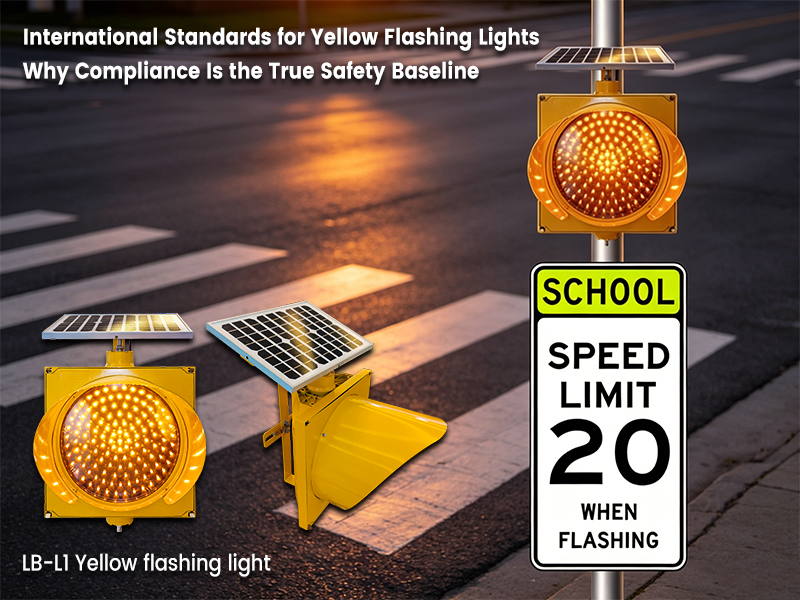
International Standards for Yellow Flashing Lights: Why Compliance Is the True Safety Baseline
A solar yellow flashing light is not an ordinary lighting device. Its flash rate, intensity, and color directly determine whether a driver can perceive a hazard in time. Yet an often-overlooked fact is that many yellow flashing lights in service no longer meet the technical standards of their respective countries.
The U.S. MUTCD standard requires a flash rate of 50 to 60 flashes per minute for yellow warning lights. The European EN 12352 standard specifies a rate of 55 to 65 flashes per minute, along with minimum luminous intensity requirements for both daytime and nighttime.
When the flash rate falls below the standard, a driver's peripheral vision struggles to detect the signal. When it exceeds the standard, the light appears as a continuous glow, losing its warning effect. In solar-powered lights, over time, battery voltage drop and circuit aging can cause frequency drift and intensity decay.
Three Core Parameters
1. Flash rate
- MUTCD: 50–60 flashes per minute
- EN 12352: 55–65 flashes per minute
- A deviation greater than 10% is considered non‑compliant.
2. Rise time
Rise time is the duration required for the light to go from off to full intensity. Standards require an instantaneous rise (typically less than 100 ms). A gradual increase reduces the warning effectiveness.
3. Luminous intensity
EN 12352 Class 2 requires: no less than 40 cd at night and no less than 400 cd during the day.
LB‑L1 Technical Specifications
| Parameter | LB‑L1 Specification |
|---|---|
| Flash rate | 50 ± 2 flashes per minute |
| LED configuration | 125 high‑brightness yellow LEDs |
| Lens diameter | 300 mm PC lens (UV‑treated, color stability outdoors ≥3 years) |
| Battery | 12 V / 10 Ah LiFePO₄, expected cycle life 3–5 years |
| Solar panel | 18 V / 10 W monocrystalline silicon |
| Ingress protection | IP65 |
| Sun visor design | Aluminum alloy sun visor, width >40 cm |
| Continuous overcast runtime | 72 hours (based on battery capacity and power‑saving mode) |
| Installation | Pre‑assembled at factory, no external power wiring required |
Design note: The parameters above are based on product design specifications. The flash rate is locked by a constant‑frequency circuit and is not affected by battery voltage.
Why Long‑Term Compliance Matters More
Many products can provide a qualified factory test report, but they cannot guarantee that they will still be compliant six months after installation. LB‑L1 uses constant‑frequency drive (stable flash rate) and constant‑current drive (stable intensity), combined with the cycling stability of LiFePO₄ batteries, to extend compliance from the moment it leaves the factory throughout its intended service life.
A solar warning light that meets MUTCD or EN 12352 standards — and remains compliant over time — is the true foundation of road safety.

If you are interested, please feel free to contact us for more product information and a quote.
MUTCD Standards: How to Choose the Right Barricade Light Color?
How Do Solar Road Studs Work? Analysis of Two Core Technical Solutions
Related Article