
MUTCD Standards: How to Choose the Right Barricade Light Color?

MUTCD Standards: How to Choose the Right Barricade Light Color?
Choosing the correct barricade light color for road construction directly impacts MUTCD compliance and job site safety. This article helps you quickly understand which color to use where.
1. Why Does Color Matter?
- MUTCD assigns legal meanings to each color.
- Wrong color → site confusion, accident risk, DOT fines.
- Work zone warning devices must use orange as the background color (distinct from regular yellow warning signs).
2. The Four Colors and Their Correct Use
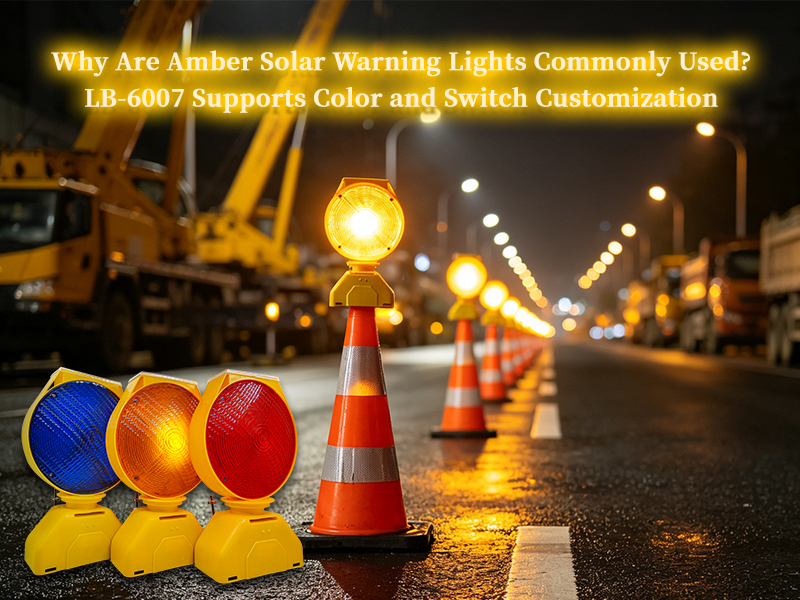
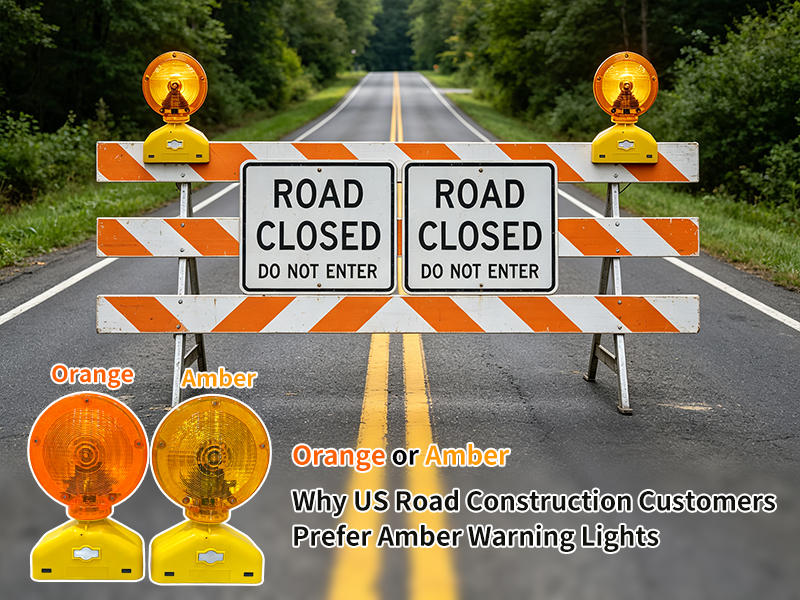
🟡 Amber/Yellow – The Standard Choice for Most Road Work
- Use for: Lane closures, detours, temporary lane occupancy – nearly all routine construction.
- MUTCD meaning: Warning / Caution → prompts drivers to slow down.
- Key takeaway: In the vast majority of road construction projects, amber barricade lights are the most common and cover almost all warning needs. Only consider red lights when traffic must be forcibly blocked under extreme danger.
🔴 Red – Extreme Danger / Do Not Enter
- Use for: Full road closure, crash sites, collapse zones.
- MUTCD meaning: Stop / Danger.
- Note: Often paired with white reflective stripes – highest warning level.
- Limitation: Red is only for scenarios requiring mandatory traffic stop under extreme hazardous conditions.
🔵 Blue – Law Enforcement & Emergency Only
- MUTCD rule: Reserved exclusively for police and emergency vehicles.
- Permitted uses: Temporary traffic control, special safety zones, airport guidance, private roads.
- Strictly prohibited: On public road construction sites (misuse can mislead drivers and create legal risks).
🟢 Green – Safe Passage / Emergency Info
- Emerging use: Indicates "hazard cleared" or "you may proceed."
- Current status: Still limited to emergency or innovative applications; rarely used in routine construction.
3. Beyond Color: Function Modes (Type A vs. Type C)
After deciding on color, you also need to pay attention to MUTCD function modes.
| Mode | Light Behavior | Purpose | Non-Compliance Risk |
|---|---|---|---|
| Type A | Flashing | Warn of specific hazards (potholes, debris) | Cannot be used for channelization |
| Type C | Steady-burn | Must be used for lane tapers and channelization | Using flashing lights in a taper = violation |
Additional requirement: Nighttime barricade lights must be visible from 3,000 feet (approx. 914 meters) on a clear night.
4. Advantages of Solar-Powered Barricade Lights
For engineering applications in Europe and North America, solar barricade lights offer a forward-looking solution.
- Built-in photocell sensor – automatic on/off.
- MUTCD-compliant and maintenance-free.
- Significantly reduces field labor and battery replacement costs for long-term projects.
5. Product Reference: LB-5100US
Using MUTCD-compliant barricade lights with authoritative certifications helps ensure project compliance.
The LB-5100US LED D‑battery barricade light features:
- MUTCD-compliant colors: amber, red, etc.
- Supports Type A flashing and Type C steady-burn modes.
- Certified with FCC, IC, CE, RoHS.

6. Final Note
If you are looking for MUTCD-compliant barricade light products, please feel free to contact us for more information or a quote.
How to Select ICAO-Compliant Aviation Obstruction Lights for Buildings Under 45 Meters
International Standards for Yellow Flashing Lights: Why Compliance Is the True Safety Baseline
Related Article