

How Do Solar Amber Flashing Beacons Improve Road Safety on Sharp Curves, Blind Spots, and Construction Zones?

How Do Solar Amber Flashing Beacons Improve Road Safety on Sharp Curves, Blind Spots, and Construction Zones?
Sharp curves, limited-visibility road sections, and construction zones are typically high-risk areas in road traffic environments. The main issue is not simply a lack of signage, but the insufficient time drivers have to perceive and respond to upcoming road conditions before reaching critical decision points.
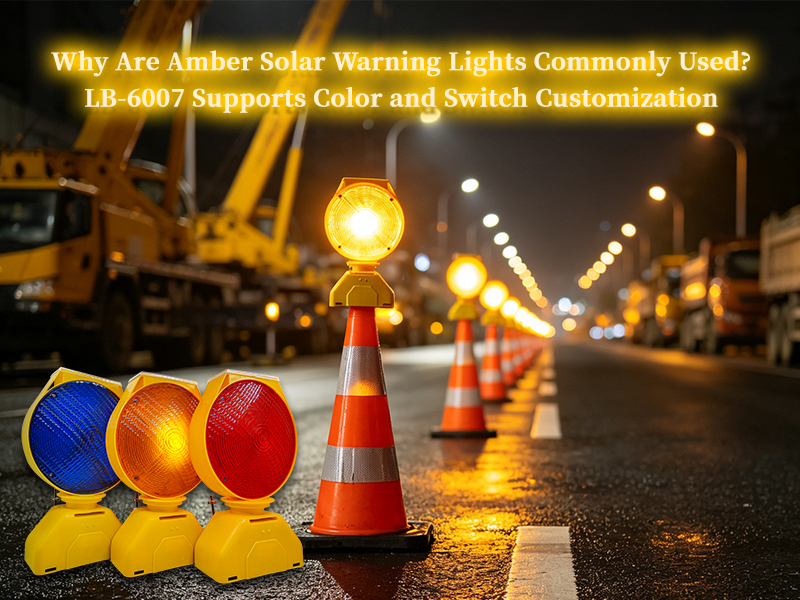
Solar amber flashing beacons are used in these locations to provide continuous visual warning signals, helping drivers detect hazards earlier and extend their reaction time.
Why Are Sharp Curves and Blind Spots High-Risk Areas?
From a traffic engineering perspective, the risks in these sections are mainly caused by information discontinuity:
- Oncoming vehicles cannot be seen in advance
- Road geometry creates visual obstruction at curves or hilltops
- Night-time conditions reduce effective sight distance
- Road conditions change within a very short reaction distance
When drivers cannot access complete real-time information, decisions rely more on experience than visual confirmation, increasing the risk of delayed reactions.
How Are These Risks Managed in Road Engineering?
In road safety engineering, active visual warning devices are commonly used to create advance alert points before hazardous sections.
Solar amber flashing beacons are widely used in this approach. Installation is based on the safe stopping sight distance principle, meaning the device should be placed where drivers still have enough distance to slow down safely after seeing the warning signal.
This ensures the warning is both visible and actionable.
Solar Amber Flashing Beacon (LB-L1) Technical Specification
The LB-L1 solar amber flashing beacon is designed for long-term road engineering applications with the following configuration:
- Solar Power System: 18V 10W photovoltaic module for off-grid operation
- Lighting System: 125 high-brightness 5mm LEDs for stable long-distance visibility
- Battery System: 12V 10Ah lithium iron phosphate battery for extended night and low-sunlight operation
- Flashing Frequency: Adjustable 40–60 flashes per minute for consistent visual recognition
- Structure: Polycarbonate housing with aluminum components for durability and weather resistance
The unit is fully integrated and ready for direct installation without external grid power.

Typical Application Scenarios
- Mountain road sharp curves
- Limited sight-distance hilltops and dips
- High accident-prone road sections
- Unsignalized intersections
- Road construction and temporary diversion zones
- Highway ramp merging and diverging areas
These locations share a common requirement: drivers must receive road condition information earlier to make safe driving decisions.
Outdoor Reliability and Performance
- Independent solar-powered operation without grid dependency
- Stable performance under extended cloudy or rainy conditions (depending on sunlight availability)
- Sealed structure for rain, dust, and environmental exposure resistance
- Suitable for both permanent and temporary road installations
Conclusion
Solar amber flashing beacons play a key role in road safety systems by providing early visual warning signals that extend driver reaction time in complex road environments.
The LB-L1 is suitable for multiple road engineering applications and operates reliably without external power, making it a widely used device in traffic safety systems.
For more information and quotations of the LB-L1 solar amber flashing beacon, please feel free to contact us. We can provide suitable solutions based on your road engineering requirements.
How Poor Warning Lights Lead to Road Accidents in Construction Zones
Why Are Solar Warning Lights Increasingly Important in Road Construction and Temporary Traffic Safety?
Related Article