

How Do Solar Road Studs Work? Analysis of Two Core Technical Solutions
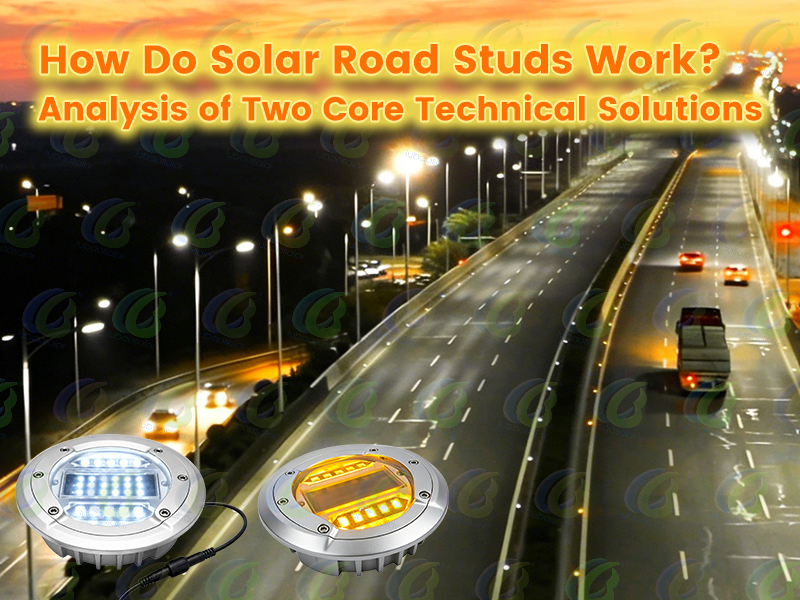
How Do Solar Road Studs Work? Analysis of Two Core Technical Solutions
In complete darkness, solar road studs provide over 800 meters of visibility – nearly nine times that of traditional reflective studs (≈90 m). The key is integrating photovoltaic generation, energy storage, and intelligent light control into a self-contained unit rising only about 11.5 mm above the road.
This article uses the LS-68 solar-powered model and the LS-68 hardwired synchronized model as examples. The LS-68 series features a 50‑ton compression-resistant cast aluminum housing, IP68 waterproof rating, -40°C to 70°C operating range, and holds full certifications including FCC, CE, IC, RoHS, and EN1463‑3.
1. What Are the Core Differences Between Solar and Hardwired Synchronized Road Studs?
The fundamental difference lies in power supply and signal synchronization. The solar model is self‑powered (PV + battery) with no external wiring; the hardwired model requires external power but can synchronize with traffic lights in real time.
| Feature | LS-68 Solar Model | LS-68 Hardwired Synchronized Model |
|---|---|---|
| Power supply | Self-powered (PV + battery) | External power (buried cable) |
| Typical applications | Rural roads, unlit tunnels, mining roads | Urban intersections, crosswalks, toll plazas |
| Visibility distance | ≥800 m | ≥1000 m |
| Traffic-light sync | No | Yes |
2. How Does the Solar-Powered Model Achieve Self‑Sufficiency?
The LS-68 solar model protrudes only 11.5 mm and withstands 50 tons. Its cycle:
- Daytime capture: PV panel (efficiency 18%–22%) converts sunlight to DC electricity. Controller stores energy in lithium battery (cycle life ≥1000) and prevents overcharging.
- Night illumination: Below 50 Lux, LEDs automatically turn on (steady/flashing mode selectable); above 100 Lux at dawn, switches back to charging.
This model uses 6 high‑brightness LEDs (80 lumens each) in two‑sided or single‑sided configuration. Housing is corrosion‑resistant aluminum alloy + polycarbonate with tempered glass top. Comes with pre‑fitted sealing gasket; on‑site installation requires only drilling and fixing with bolts. Suitable for roads without power infrastructure.
3. How Does the Hardwired Synchronized Model Achieve Traffic‑Light Synchronization?
This model draws power via buried cable and connects directly to the traffic signal controller:
- Red light on → studs illuminate red, forming a stop boundary.
- Green light on → instantly switch to green, guiding vehicles.
It supports dual‑color (red+green) switching, features 28 LEDs (10 side + 18 center) with total luminous flux >2000 lumens. Housing height remains 11.5 mm. Verified according to EN1463‑3.
4. Why Are FCC, CE, IC, RoHS, and EN1463‑3 Certifications Important?
- FCC: U.S. electromagnetic compatibility – no interference with communication equipment.
- CE: EU mandatory safety certification, together with EN1463 series.
- IC: Canadian electromagnetic compatibility proof.
- RoHS: Restricts six hazardous substances – environmental compliance.
- EN1463‑3: Dedicated performance standard for active road studs (optical, mechanical, environmental tests).
A stud meeting EN1463‑3 and holding CE, FCC, IC, RoHS satisfies technical access requirements for major global markets.
5. Key Technical Differences Between Solar and Hardwired Synchronized Models
| Aspect | LS-68 Solar Model | LS-68 Hardwired Synchronized Model |
|---|---|---|
| On‑site power required | No | Yes (buried cable) |
| Traffic‑light sync | No | Yes (red/green) |
| Night visibility | ≥800 m | ≥1000 m |
| Compressive/Waterproof/Temp | 50t / IP68 / -40~70°C | Same |
| Certifications | Full set | Same |
6. How to Choose the Right Model?
- Choose solar model for sites without power supply (rural roads, unlit tunnels, mining roads, island roads) requiring quick deployment and zero electricity cost. Its energy storage handles overcast conditions.
- Choose hardwired synchronized model for urban arterials, signalized intersections, crosswalks, smart traffic zones where power is available or planned, and lane‑marking lights must interlock with traffic signals.
Both models offer 50‑ton compressive strength, IP68 waterproofing, wide operating temperature, and full certifications – a reliable foundation for long‑term maintenance‑free operation. For technical specifications, model comparison, or pricing, please contact us.


International Standards for Yellow Flashing Lights: Why Compliance Is the True Safety Baseline
How Do LED Road Flares Work? 10 Modes & Usage Scenarios Explained
Related Article