
Why Do Traditional Stop Signs Fail in Bad Weather? How to Fix Intersection Blind Spots Effectively?

Why Do Traditional Stop Signs Fail in Bad Weather? How to Fix Intersection Blind Spots Effectively?
At any road intersection, the "STOP" sign is the most fundamental and critical traffic control command. However, in real-world scenarios, if a driver cannot see it in time, the sign completely loses its legal and safety enforcement power.
Why Do Traditional Passive Reflective Signs Fail in Bad Weather?
Traditional stop signs rely entirely on their reflective sheeting for passive reflection. This means they must wait for vehicle headlights to illuminate them before becoming visible. In actual road environments, this passive approach has two major natural limitations:
- Severe Weather Interference: Heavy rain, blizzards, and thick fog severely scatter and weaken light. As a result, retroreflectivity drops drastically, and drivers are often forced into a dangerous distance before barely noticing the sign.
- Low-Light and Dark Rural Roads: On remote roads without streetlights, or if a vehicle has dim headlights, the reflection distance is drastically shortened. This leaves the driver with almost zero time to react and brake safely.
These environmental factors lead to a common, dangerous outcome: drivers only discover they need to stop when they are already entering the intersection, causing frequent hard braking or collisions. This is not due to driver negligence, but rather the performance limitations of passive warning methods under extreme conditions.
How Do Solar Active Warning Systems Warn Drivers Ahead of Danger?
To eliminate these environmental uncertainties, modern traffic engineering introduces active warning technology. The core concept is shifting from "waiting to be seen" to "actively emitting a warning."
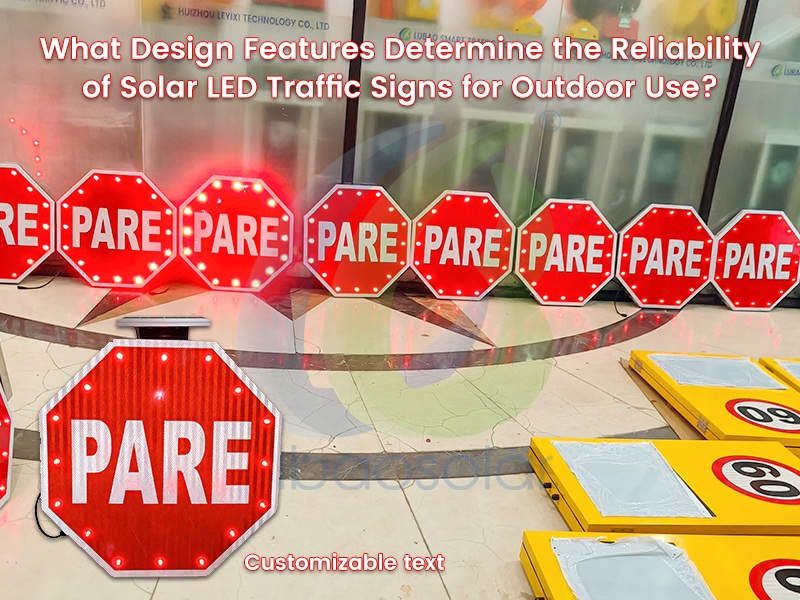
The LB-TTS01 Solar LED Stop Sign features embedded high-brightness LED arrays controlled by microprocessors to flash continuously at standard frequencies. Long before vehicle headlights can even reach the sign's blind spot, drivers can clearly catch the flashing red "STOP" signal from hundreds of meters away, gaining precious deceleration time.
To ensure absolute safety under any extreme operational conditions, the equipment incorporates a dual-redundancy mechanism:
- Active Warning Layer: Powerful LED flashing provides exceptional visual penetration through blizzards, dense fog, and dark nights.
- Passive Protection Layer: The sign body integrates premium 3M reflective sheeting. Even in the highly rare event of a solar system failure, it still functions perfectly as a traditional reflective sign, ensuring 24/7 compliance with road regulations.
How Does the System Ensure Uninterrupted Operation and Waterproof Protection?
For remote intersections or regions with high rainfall and heavy snow, equipment uptime and weatherproof capabilities directly determine the long-term quality of a road project.
The LB-TTS01 is engineered with a high-efficiency monocrystalline solar panel and an industrial-grade intelligent energy storage system. Driven by internal power-management algorithms, a single full charge allows the device to maintain its normal flashing frequency even during consecutive days of zero sunlight. For installation, it is recommended to choose an unobstructed location and regularly clean the surface of snow or dust to maintain long-term charging efficiency.
In terms of waterproof engineering, the device utilizes an industrial-grade protective solution:
- Lock-Sealed Heavy-Duty Structure: Featuring a robust aluminum alloy casing equipped with a PG7 waterproof connector, it completely prevents moisture or heavy downpours from penetrating the internal electronics.
- Silicone Switch Shield: The main power switch is independently shielded by a waterproof silicone sleeve, eliminating any risk of rainwater infiltration. This fully sealed protective design guarantees stable, long-term outdoor operation under harsh climates.
Conclusion: Eliminating Safety Blind Spots with Active Warning
Most intersection accidents stem from "not seeing" or "seeing too late." Solar active warning signs utilize physical light emission to compensate for traditional signs' heavy dependence on external environments. This ensures that the STOP sign remains clearly identifiable under any weather and light conditions.
If you are currently evaluating intersection safety upgrade plans or need to enhance active protection levels for specific road sections, please contact us below to obtain technical data sheets and project support.

Why Some Radar Speed Signs Fail to Slow Down Drivers
How LED Traffic Batons Improve Safety and Efficiency in Different Scenarios
Related Article