

How to Balance Efficiency and Safety in Temporary Lane Closures? Traffic Cones vs. Speed Bump with Warning Posts
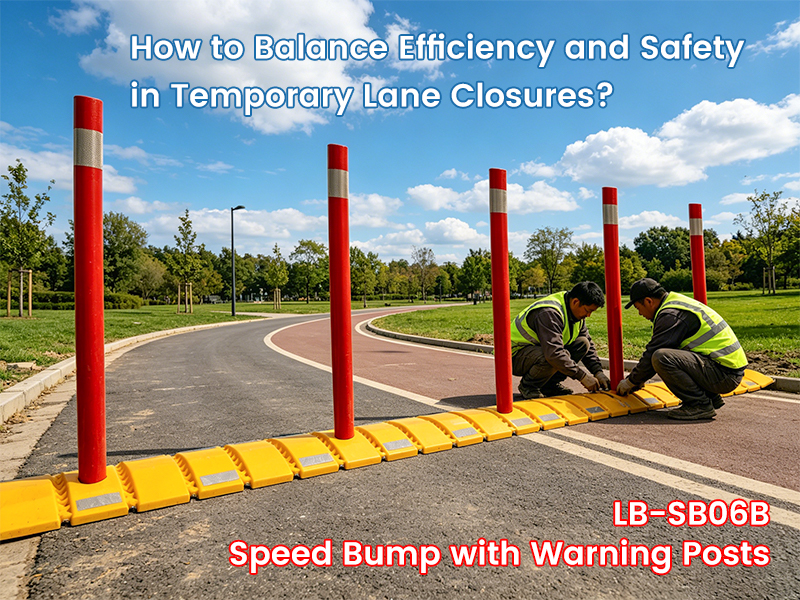
How to Balance Efficiency and Safety in Temporary Lane Closures? Traffic Cones vs. Speed Bump with Warning Posts
Temporary lane closures are a critical component of ensuring construction safety. For engineering projects with high-frequency relocations and tight schedules, finding a way to enhance deployment efficiency while maintaining absolute safety has become a top priority for contractors.
📌 Product At-a-Glance:
- Dimensions: 300cm × 22.5cm × 4.5cm, equipped with 5 × 80cm high vertical posts covered in red-and-white reflective sheeting
- Load Capacity: 30 tons (functions as a speed bump when the posts are folded down)
- Weight: Approx. 16kg (the warning posts weigh approx. 1.2kg in total)
- Dual-Mode Configuration: Posts upright → Lane Closure Mode; Posts folded down → Speed Bump Pass-Through Mode
1. Application Scenarios and Characteristics of Traditional Traffic Cones
Traffic cones are mature, universally accepted solutions for long-distance, semi-permanent traffic diverting due to their controllable costs, broad adaptability, and ease of replenishment. However, in short-cycle, high-frequency relocation work zones, traditional methods and portable integrated systems serve distinctly different operational priorities:
- Deployment Method: Traffic cones require multiple workers for sequential manual placement, ballasting, and retrieval. Portable systems can be unrolled and deployed rapidly by a single operator.
- Nighttime Identification: Traffic cones function as low-profile, ground-level reflective devices, making long-range visual detection relatively limited. Portable systems utilize 80cm high-visibility reflective posts to provide significantly higher nighttime visibility.
- Guidance Mechanism: Traffic cones rely entirely on passive, flexible visual guidance. Portable systems provide a clear physical separation boundary when the posts are upright, and function effectively as a tactile speed bump when the posts are folded down.
Rather than being mutually exclusive, these two methodologies are highly complementary and excel in distinct operational environments.
2. Technical Efficiency & Functionality Comparison Matrix
| Evaluation Metrics | Traditional Traffic Cones | LB-SB06B Speed Bump with Warning Posts |
|---|---|---|
| Deployment Efficiency | Requires multiple workers for manual placement | Single operator; rapid execution |
| Warning Height | Ground-level profile | 80cm high-visibility vertical posts |
| Nighttime Visibility | Ground-level reflectivity | High-visibility reflective sheeting; extended detection distance |
| Load-Bearing Capacity | Not rated for vehicle overruns | Functions as a speed bump with a 30-ton load capacity when posts are down |
| Pavement Impact | Zero damage (requires manual ballast) | Zero damage; completely tool-free, surface-laid |
| Primary Scenarios | Long-distance, semi-permanent traffic routing | Short-cycle, high-frequency mobile work zones |
3. Three Core Advantages of the Speed Bump with Warning Posts
A. 3D Visual Boundaries + High-Visibility Sheeting
The 5 vertical warning posts align horizontally to establish a highly prominent, multi-dimensional visual barrier. Wrapped in premium retroreflective sheeting, the system generates powerful reflectivity under vehicle headlight illumination. This exceptional visibility ensures that drivers can identify the hazard from an extended distance and execute proactive deceleration or lane changes.
B. Engineered Dual-Mode Functionality
- Closure Mode: When the warning posts are upright, vehicles are strictly prohibited from entry, acting as a clear physical partition for closed lanes.
- Speed Bump Mode: When the posts are folded down, the base structure functions as a temporary speed bump with a 4.5cm height profile and 30-ton load capacity. This configuration allows engineering vehicles to pass over smoothly at low speeds. Should an operational oversight occur, the tactile dampening and vibration from the speed bump prompt the driver to correct course immediately.
C. Rapid Deployment minimizing Operational Overhead
Weighing just 16kg, the entire system utilizes a modular, compact folding architecture for easy storage in standard utility vehicles. A single operator can complete setup or breakdown rapidly without any destructive pavement drilling or post-construction road repair expenses, ensuring fast and highly efficient relocations.
4. Conclusion: Tactical Equipment Selection Based on Project Scope
Conventional traffic cones remain the baseline industry requirement for long-range, semi-permanent traffic routing. However, the speed bump with warning posts serves as an indispensable, high-efficiency tactical supplement for short-cycle, high-frequency road maintenance operations. Contractors should evaluate factors such as project durations, night work frequencies, and relocation rates to flexibly combine these equipment types for an optimized balance between work zone safety and operational efficiency.
5. Upgrade Your Work Zone Safety Configurations Today
The LB-SB06B Speed Bump with Warning Posts is optimized for immediate commercial and municipal procurement, serving key applications including: municipal road maintenance, utility pipeline emergency repairs, school crossings, security checkpoints, night shifts, and low-visibility weather construction zones.
Our B2B Procurement Services Include:
- Product quotation sheets and itemized technical data packets (delivered instantly).
- Tiered commercial volume pricing models and global logistics freight solutions.
Contact Us Today to Receive Your Tailored Strategy!
Make every temporary lane closure safer and more efficient.
Why Are Airports and Banks More Likely to Choose Double Layer Queue Barriers?
Why Some Radar Speed Signs Fail to Slow Down Drivers
Related Article