
How to Select ICAO-Compliant Aviation Obstruction Lights for Buildings Under 45 Meters
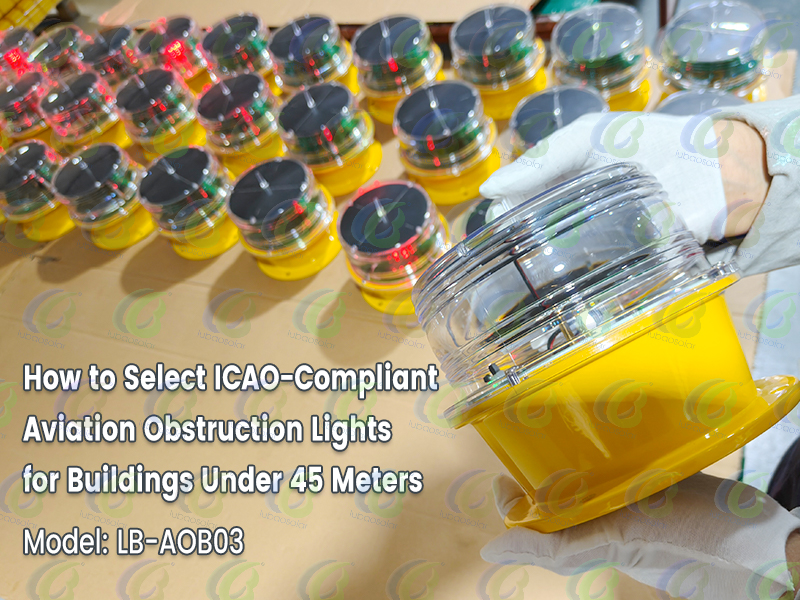
How to Select ICAO-Compliant Aviation Obstruction Lights for Buildings Under 45 Meters
According to ICAO Annex 14, 7th Edition, obstacles not exceeding 45 meters in height shall be equipped with low-intensity aviation obstruction lights. Significant differences exist among products in parameters such as light intensity margin, battery autonomy, and environmental adaptability – differences that directly affect long‑term reliability. Using the LB‑AOB03 solar‑powered obstruction light as an example, this article outlines five technical aspects to consider during selection.
1. Light Intensity Output
ICAO low‑intensity Type A requires a minimum of 10 cd (red steady). Some products are designed only to meet this threshold, but LED depreciation and lens soiling reduce effective output over time. The LB‑AOB03 delivers >18 cd measured – 80% above the ICAO Type A requirement, ensuring continued compliance after years of operation. It also meets FAA L‑810, making it suitable for international projects that require both ICAO and FAA standards.
2. Battery Autonomy
The main challenge for solar‑powered lights is operation during extended periods without sunlight. Most comparable products offer 40–60 hours in steady mode. The LB‑AOB03 runs 60+ hours in steady mode, and in flashing mode (20 fpm, compliant with ICAO Type E) it exceeds 120 hours – equivalent to five consecutive cloudy/rainy days with zero sunlight. This autonomy is especially critical for foggy, rainy or high‑altitude winter regions.
3. Operating Temperature Range
Typical aviation obstruction lights operate between -30°C and 55°C. The LB‑AOB03 is rated from -55°C to 70°C, covering extreme winter lows in cold regions as well as high‑temperature solar radiation on metal towers, preventing low‑temperature lock‑out or over‑temperature shutdown.
4. Physical Protection
IP68 is the highest ingress protection rating under IEC 60529, allowing prolonged submersion – ideal for rooftops or tower tops where water pooling and ice formation occur. Wind resistance is rated at 80 m/s (≈288 km/h), exceeding Category 12 typhoon levels. The housing uses a powder‑coated die‑cast aluminium base and a UV‑stabilised polycarbonate lens, designed for long‑term outdoor exposure to sunlight, salt spray and thermal cycling.
5. Optional Features
- GPS sync flash – Synchronises multiple lights without extra cables, suitable for tower clusters or wind farms.
- Infrared LED (NVG compatible) – Emits IR for pilot night vision goggles, typically required in military or certain civil aviation zones.
- Physical lightning protection – Solar‑powered, low‑voltage, completely isolated from external cables, eliminating surge paths into equipment rooms.
The standard version already meets basic ICAO and FAA requirements. The above options are available on demand.
Selection Checklist
| Item | Technical Requirement |
|---|---|
| Compliance | ICAO Annex 14 (Type A/E) and FAA L‑810 |
| Actual intensity | Significantly above 10 cd (≥15 cd recommended) |
| Autonomy (no sunlight) | ≥120 hours in flashing mode |
| Operating temperature | Covers site extreme temperatures |
| Protection & wind | IP68, wind resistance ≥80 m/s |
For complete technical datasheets or a project‑specific quotation, please contact us.

How Long Do IP54 Warning Lights Last? Outdoor Lifespan and Buying Guide
MUTCD Standards: How to Choose the Right Barricade Light Color?
Related Article