

How to Choose the Right Offshore Heliport Light for Safe Night Landings?
author: Lena Guan
2026-03-17

How to Choose the Right Offshore Heliport Light for Safe Night Landings?
Heliport lights (Heliport Light / Helipad Light) are essential for safe helicopter landings at night or in low-visibility conditions. Offshore environments are challenging: high winds, salt spray, and low night visibility demand brightness, durability, and reliability.
LB‑HP‑I LED Heliport Light is designed for various environments, combining high brightness, long lifespan, and low-maintenance advantages to help pilots safely identify landing zones.
🌫️ Offshore Helipad Challenges & Solutions
Visibility Issues
High winds and salt spray can weaken ordinary lights.
Solution: LB‑HP‑I provides 360° omnidirectional illumination with ICAO vertical coverage. IP68 protection ensures reliable performance in water, dust, and salt spray.
High winds and salt spray can weaken ordinary lights.
Solution: LB‑HP‑I provides 360° omnidirectional illumination with ICAO vertical coverage. IP68 protection ensures reliable performance in water, dust, and salt spray.
High Maintenance Costs
Frequent inspections and downtime reduce operational efficiency.
Solution: LED lifespan >100,000 hours and low power consumption reduce maintenance and helipad downtime.
Frequent inspections and downtime reduce operational efficiency.
Solution: LED lifespan >100,000 hours and low power consumption reduce maintenance and helipad downtime.
Unclear Marking
Pilots need fast recognition of landing points, boundaries, and warning zones.
Solution: Green/Blue/Red/Yellow indicators provide intuitive guidance for night landings.
Pilots need fast recognition of landing points, boundaries, and warning zones.
Solution: Green/Blue/Red/Yellow indicators provide intuitive guidance for night landings.
🌟 Technical Advantages & Reliability
LB‑HP‑I LED Heliport Light delivers outstanding performance in brightness, durability, and environmental adaptability:
-
High Brightness & Long Lifespan: High luminous flux, 5500–6000K, LED lifespan >100,000 hours
-
Strong Environmental Adaptability: IP68 waterproof/dustproof/corrosion-resistant, shockproof
-
Clear Multi-Color Indicators: Green for landing, Blue for boundary, Red/Yellow for warning zones
-
Low-Maintenance Design: Reduces inspections and downtime
LB‑HP‑I provides stable, clear, and safe illumination for night and harsh-condition helicopter landings.
🏝️ Multi-Scenario Applications
LB‑HP‑I LED Heliport Light is suitable for various environments:
-
Offshore platforms: Clear visibility in wind, salt spray, or night
-
Hospital helipads: Frequent night emergency landings
-
Urban rooftop helipads: High brightness in complex environments
-
Remote or emergency helipads: Reliable under limited power/maintenance
-
Industrial/fire station helipads: Corrosion and impact resistant
LB‑HP‑I delivers stable, clear, and safe illumination across scenarios.
✅ Conclusion
Choosing a heliport light involves brightness, environmental adaptability, maintenance, and clear marking. LB‑HP‑I is a reliable solution for safe night landings.
What Are the Key Advantages of Solar Marine Lights for Port and Waterway Navigation?
Why Solar Aviation Obstruction Lights Are Replacing Traditional Lights
Related Article

Why are red and white aviation obstruction lights needed for tall structures? The LB-MI-AB-B3-L uses LED technology and dual-color lighting to provide reliable aviation warning for towers, buildings, chimneys, and wind turbines.
Why Are Red and White Aviation Obstruction Lights Important for Tall Structures?

Learn why towers and buildings use Medium Intensity Aviation Obstruction Lights. Discover LED aviation obstruction light applications, selection tips, and the GZ-155 warning light solution.
Why Towers and Buildings Commonly Use Medium Intensity Aviation Obstruction Lights?
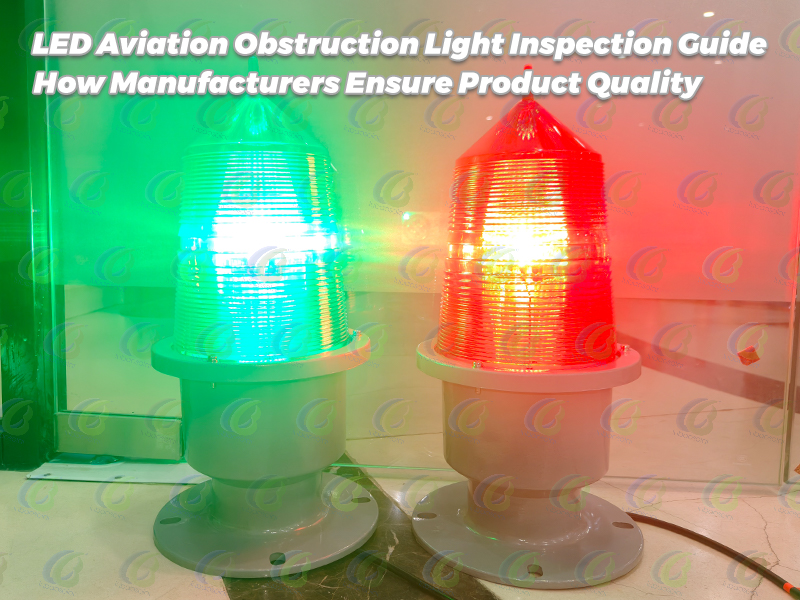
Learn how an LED Aviation Obstruction Light Manufacturer ensures product quality through 100% pre-shipment inspection, including appearance checks, LED testing, electrical inspection, and quality control procedures.
LED Aviation Obstruction Light Inspection Guide: How Manufacturers Ensure Product Quality
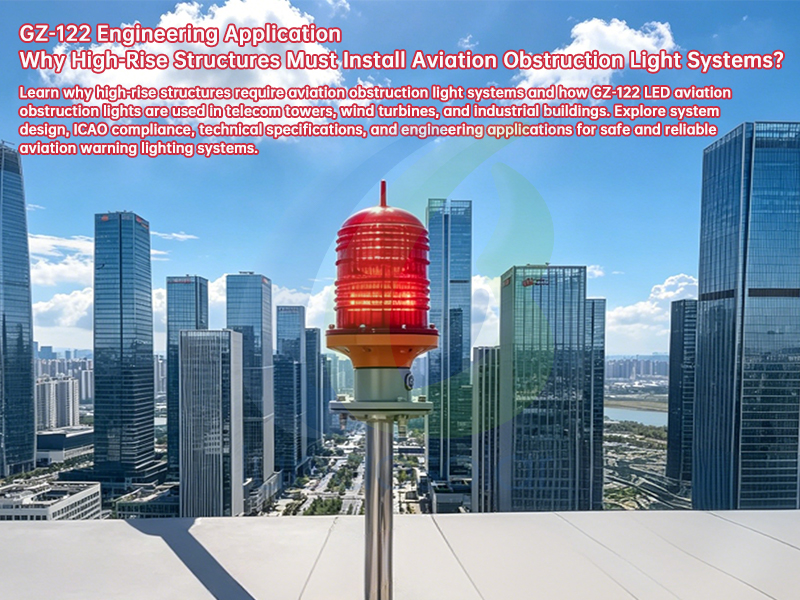
Learn why high-rise structures require aviation obstruction light systems and how GZ-122 LED aviation obstruction lights are used in telecom towers, wind turbines, and industrial buildings. Explore system design, ICAO compliance, technical specifications, and engineering applications for safe and reliable aviation warning lighting systems.
Why High-Rise Structures Must Install Aviation Obstruction Light Systems? — GZ-122 Engineering Application