

2025 Heliport Lighting Market Analysis and 2026 Outlook
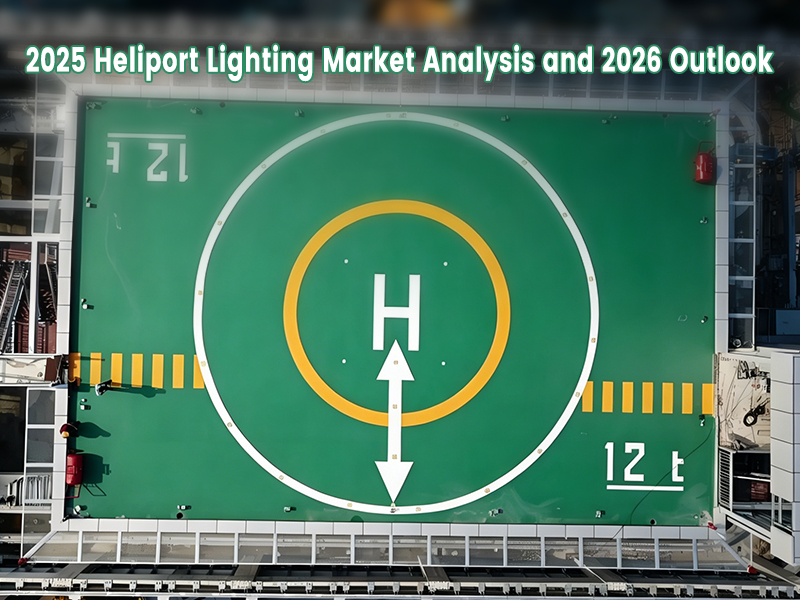
2025 Heliport Lighting Market Analysis and 2026 Outlook
1. Market Size: Steady Growth, More Active Retrofit Market
According to the QY Research 2025 report, the global LED heliport floodlight market was valued at US$3.654 billion in 2024, and is expected to reach US$4.951 billion by 2031, with a CAGR of 4.5%. The broader heliport lighting system (including approach path indicators, wind cones, beacons, etc.) was approximately US$6.928 billion in 2025 and is projected to reach US$9.081 billion by 2032, with a CAGR of 4.0%. For aircraft-mounted lights, the landing light market (US$110 million in 2024, CAGR 10.0%) and the parking light market (US$184 million in 2025, CAGR 8.56%) both show significantly higher growth rates than new helipad construction, indicating a more active retrofit market.
2. Regional Landscape: North America Leads, Asia-Pacific Fastest Growing
- North America: Largest market, dense HEMS network, strict FAA regulations, large retrofit demand.
- Europe: Highest regulatory bar, mandatory CAP 437, driven by offshore wind O&M and UAM pilots.
- Asia-Pacific: Fastest growing, benefiting from China's low‑altitude economy, Southeast Asian tourism infrastructure, and medical evacuation network.
- Middle East & Africa: High project value, concentrated on luxury hotel and hospital rooftops, oil & gas platforms.
The 8th edition of CAP 437 (2018) requires self‑illuminated marking circles and H‑signs on offshore helicopter decks. A large number of platforms worldwide have not yet completed the retrofit, making compliance a major growth driver in 2026.
3. Application Segments: Medical and Offshore Energy Dominate
| Application | Typical Scenarios | Core Requirements | Market Trend |
|---|---|---|---|
| Medical & Emergency Services | Hospital rooftops, rescue bases | 24/7 availability, anti‑glare | Steady growth |
| Offshore Energy | Oil & gas platforms, wind‑farm service vessels | Corrosion resistance, explosion‑proof, CAP 437 | Rapid growth |
| Commercial & Private | Hotels, office buildings, private helipads | Aesthetic, low light pollution | Fastest in Asia‑Pacific |
| Remote / Emergency | Mountain, jungle, temporary sites | Solar power, portable | Small base but fast |
Medical and offshore energy together account for more than half of the market. Offshore wind O&M is becoming a new growth engine.
4. 2025 Mainstream Product Types and Technical Specifications
| Lamp Type | Core Function | 2025 Mainstream Specifications |
|---|---|---|
| Elevated Edge Light | Marks TLOF boundary | Power >50W or ≤50W; tilt‑adjustable; white/green; frangible |
| Inset Edge Light | Boundary on elevated helipads | Protrusion <15mm; omnidirectional; high compressive strength |
| Floodlight | Uniform surface illumination | Illuminance ≥10 Lux; anti‑glare; 30-90W |
| HAPI (Helicopter Approach Path Indicator) | Guides approach angle | Red/white bicolor; visibility ≥5 km |
| Heliport Beacon | Long‑range identification | White flashing; recognition ≥5 km |
| Marking Circle / H‑sign | Mandatory under CAP 437 | Yellow circle / green H; ≥16 discrete segments; self‑illuminated |
| Wind Cone Lighting | Wind direction information | Even illumination; anti‑icing; frangible |
Power selection and materials: Low‑power (≤50W) suitable for hospital rooftops and private helipads; high‑power for offshore platforms. Housing uses marine‑grade aluminium alloy or IP68 stainless steel; PC lens; LED dominates. Fibre optic systems for high‑end buildings (no FOD risk); solar for remote areas.
5. Quality Issues Observed in 2025
ICAO requires that floodlights “shall not cause glare to pilots.” Some products use bare LEDs with simple reflectors, causing excessive stray light and interfering with approach judgement. Offshore and elevated helipads face salt spray, impact, and water ingress: insufficient anodising leads to corrosion and seizing; ordinary glass lenses shatter when struck by FOD; poor sealing causes short circuits. Poor thermal design accelerates lumen depreciation, destroying illuminance uniformity after 2‑3 years; inferior power supplies fail frequently under voltage fluctuations. Qualified products need multi‑lens optics, marine‑grade materials, IP67 (IP68 offshore), PC lenses, proper heat dissipation, and industrial‑grade power supplies.
6. Certification Framework and Standards Compliance
| Standard/Certification | Scope | Core Requirements | Scenario Remarks |
|---|---|---|---|
| ICAO Annex 14 | Global | Illuminance ≥10 Lux, frangible | Basic requirement |
| CAP 437 | Offshore decks | Self‑illuminated, ≥16 segments | Mandatory offshore |
| FAA AC 150 | USA | System classification, installation | Export to North America |
| EASA | Europe | Aerodrome equipment approval | Export to Europe |
| ATEX/IECEx | Global | Explosion protection | Oil & gas platforms |
| IP67/IP68 | General/Offshore | IP68 mandatory offshore | Combine with above |
| Salt spray test ≥720h | Offshore/coastal | Corrosion resistance verification | Additional offshore |
Selection reference: Inland sites need ICAO+IP67; coastal add salt spray test; offshore add CAP 437+IP68+explosion‑proof.
7. 2025 Product Configuration and Technology Trends
| Scenario | Component | 2025 Mainstream Configuration | Technology Trend |
|---|---|---|---|
| Standard helipad | Elevated Edge Light | LED, ≤50W, IP67, frangible | Toward RGB adjustable colour temperature |
| Floodlight | 30-90W, anti‑glare, illuminance ≥10 Lux | Add ambient light sensor | |
| HAPI | Red/white bicolor, visibility ≥5 km | Integrate GPS/INS | |
| Beacon | White flashing, recognition ≥5 km | Add photocell control | |
| Wind Cone Lighting | Frangible wind sock + LED | Integrate wind speed/direction sensor | |
| Control Cabinet | PLC, support remote monitoring interface | Toward wireless communication | |
| CAP 437 supplement | Marking Circle Lighting | Yellow, self‑illuminated, ≥16 segments | Toward integrated LED strip |
| H‑sign Lighting | Green, self‑illuminated, separate power supply | Redundant power design | |
| Deck Edge Light | Green, IP68, marine‑grade material | Self‑diagnostic function |
Note: Exact quantities depend on helipad dimensions and ICAO design requirements.
8. 2026 Market Outlook
1. Smart and remote monitoring become standard: Sensors and wireless communication enable predictive maintenance, replacing night inspections. The labour cost of one night inspection may already exceed the hardware cost of a remote monitoring module.
2. CAP 437 retrofit continues to drive demand: The retrofit of offshore platforms is far from complete, and demand for self‑illuminated marking circles/H‑signs will persist.
3. Supply chain regionalisation in response to tariff uncertainty: 2025 US tariff adjustments have impacted global supply chains. In 2026, regionalisation (local assembly near target markets, increased local inventory) will be a key strategy to mitigate trade risks.
4. eVTOL vertiport lighting demand emerges: Although eVTOL is not yet commercial, vertiport planning has started. In the absence of dedicated standards, ICAO heliport standards are applied, making traditional products directly applicable.
Key Variables for 2026
| Variable | 2025 Status | 2026 Trend |
|---|---|---|
| Smart capabilities | Optional | Standard |
| CAP 437 compliance | Partially completed | Ongoing retrofits |
| Supply chain | Globalised | Regionalised |
| eVTOL | Planning stage | Demand release |
9. Summary
2025 Summary: Steady overall growth (4.0%-4.5%), with the landing light retrofit market growing significantly (10.0%). North America largest, Asia-Pacific fastest; medical and offshore energy are the two main application segments. Quality issues centred on glare, corrosion, and lumen depreciation. Product configuration is shifting from discrete control to centralised intelligent control, from periodic night inspections to predictive maintenance, and from single‑function devices to multi‑function integration.
2026 Outlook: Four major variables – technology (remote monitoring becomes standard), standards (CAP 437 retrofits continue), supply chain (regionalisation), and application (eVTOL demand emerges).
Radar Speed Signs: 2025 Global Market Analysis & 2026 Outlook
How to Identify Airport Taxiway Edge Lights at Night
Related Article