

What Is the Difference Between L8 and L9 Road Warning Lights Under EN 12352?
What Is the Difference Between L8 and L9 Road Warning Lights Under EN 12352?
When sourcing road warning lights for traffic management projects, you may come across the L8 and L9 classifications under EN 12352. What do these classifications mean, and how do you choose the right option for your project?
Understanding the differences can help you compare products more effectively and identify the specifications that matter for your application.
Why Is EN 12352 Important for Road Warning Lights?
EN 12352 specifies requirements for individual warning lights used in road traffic applications. These requirements cover optical performance and other technical characteristics, including luminous surface area, light intensity, color, and photometric angles.
A light's appearance or physical size alone does not determine its classification. Its optical performance and other relevant characteristics must also be considered.
What Is the Difference Between L8 and L9 Warning Lights?
L8 and L9 warning lights differ in their minimum luminous surface area and photometric measurement angle ranges.
| Specification | L8 | L9 |
| Minimum luminous surface area |
250 cm² |
700 cm² |
| Horizontal photometric measurement angle range | ±7.5° | ±1.5° |
| Vertical photometric measurement angle range | ±5° | ±1.5° |
| Subcategories | L8G, L8L, L8M, L8H | L9L, L9M, L9H |
L9 has a larger minimum luminous surface area than L8, while the specified photometric measurement angle ranges are also different. However, a larger lamp does not automatically mean it meets all the requirements for L9 classification.
Why Do L8 and L9 Have Different Subcategories?
Both classifications include subcategories with different optical performance requirements.
For example, the L8G category for yellow warning lights has a minimum reference intensity of 25 cd, while L8H has a minimum reference intensity of 1,500 cd. The L9L, L9M, and L9H categories also have different intensity requirements.
When selecting a warning light, check the required subcategory and its corresponding optical specifications rather than relying on the L8 or L9 label alone.
How to Choose the Right L8 or L9 Warning Light for Your Project
- Required classification: Confirm whether your project calls for L8 or L9 and identify the required subcategory.
- Optical performance: Check the luminous surface area, light intensity, color, and photometric angles.
- Power supply: Confirm the operating voltage and whether the available power source suits your installation.
- Operating mode: Determine whether you need steady-burning, flashing, or other warning patterns.
These details will help you narrow down suitable options and compare products according to your project requirements.
Recommended L8 and L9 LED Warning Lights
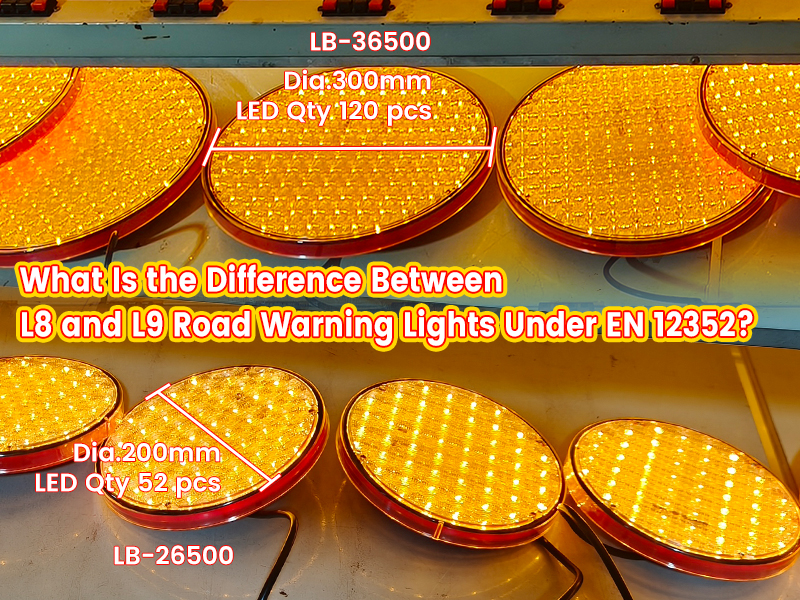
LB-26500 — 200 mm LED Warning Light (L8)
- Light size: 200 mm
- Number of LEDs: 52
- Operating voltage: 12V
- Operating modes: Synchronized flashing, sequential flashing
- Operating time: 12-hour / 24-hour configurations
- Applications: Road diversion, lane guidance, and temporary traffic control
View product details:
LB-36500 — 300 mm LED Warning Light (L9)
- Light size: 300 mm
- Number of LEDs: 120
- Operating voltage: 12V / 24V
- Operating modes: Steady-on, flashing, strobe
- Luminous surface area: ≥300 cm²
- Light intensity: >3,000 cd
- Operating temperature: −40°C to 80°C
View product details:
Looking for the Right Road Warning Light?
Contact us for product details, available configurations, and pricing. If you have specific project requirements, share them with us, and we'll help you explore suitable options.
Contact us today for a quotation and find the right road warning light for your project.
How to Use LED Road Flares in a Vehicle Emergency?
Related Article