
Why Do Coastal High-Salt Environments Require Corrosion-Resistant Embedded Solar Road Studs?
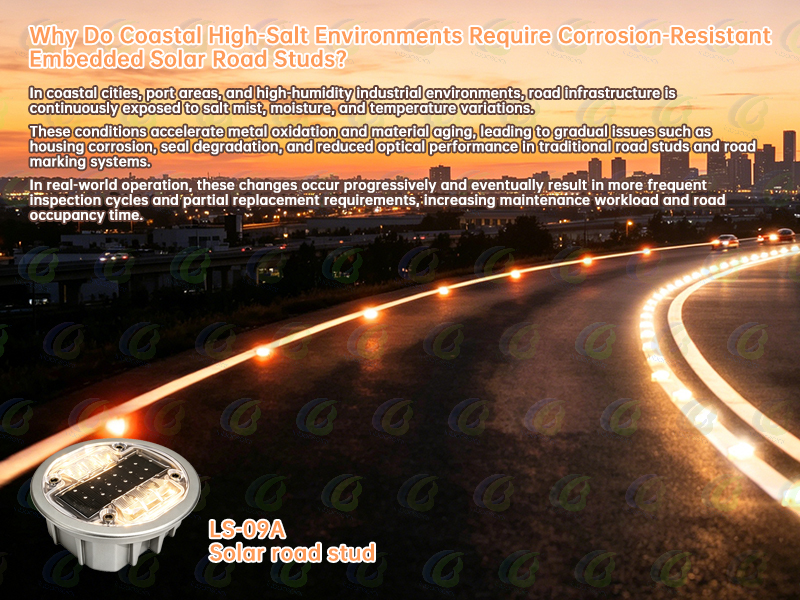
Why Do Coastal High-Salt Environments Require Corrosion-Resistant Embedded Solar Road Studs?
How Do Coastal High-Salt Environments Affect Road Infrastructure?
In coastal cities, port areas, and high-humidity industrial environments, road infrastructure is continuously exposed to salt mist, moisture, and temperature variations.
These conditions accelerate metal oxidation and material aging, leading to gradual issues such as housing corrosion, seal degradation, and reduced optical performance in traditional road studs and road marking systems.
In real-world operation, these changes occur progressively and eventually result in more frequent inspection cycles and partial replacement requirements, increasing maintenance workload and road occupancy time.
What Is an Embedded Solar Road Stud and What Are Its Engineering Features?
An Embedded Solar Road Stud is a road safety device that integrates solar power supply, night-time lane guidance, and active illumination warning functions. It is widely used in road systems requiring continuous night visibility.
Compared with traditional reflective road markers, its key features include:
- Active illumination for improved night visibility
- Independent solar power system, no external wiring required
- Embedded structure design reduces vehicle impact
- Suitable for long-term operation in high-humidity and high-salt environments
What Are the Key Specifications of LS-09A Embedded Solar Road Stud?
LS-09A adopts an embedded structural design with a low-profile height of only 6.8mm, suitable for complex climate and road guidance applications.
- Model: LS-09A
- Size: Φ137mm × H52.8mm
- Material: Corrosion-resistant aluminum alloy + polycarbonate (PC)
- Load capacity: 30 tons vehicle resistance
- LED: 6 high-brightness LEDs
- Solar panel: 0.5W / 5.5V
- Battery: LiFePO4 3.2V / 1500mAh
- Protection rating: IP68 waterproof and dustproof
- Color options: Red / Yellow / Blue / Green / White

Why Does Road Stud Service Life Decrease in High-Salt Environments?
In high-salt and high-humidity environments, the service life of road studs mainly depends on material durability and structural stability.
Corrosion-resistant aluminum alloy and polycarbonate housing help reduce long-term salt spray erosion, maintaining stable physical performance during continuous operation.
IP68 protection prevents water ingress and moisture damage to internal electronic components, reducing failure risks caused by environmental exposure.
The embedded low-profile structure reduces direct vehicle impact, helping extend maintenance cycles and reduce replacement frequency.
Where Are Embedded Solar Road Studs Typically Used?
- Urban roads and standard-grade highways for lane separation and guidance
- Coastal and high-humidity road safety marking systems
- Tunnel entrances and low-visibility road sections
- Curves, ramps, and limited-sight-distance road areas
How to Select the Right Solar Road Stud in Corrosive Environments?
In road engineering selection, embedded solar road studs are typically evaluated based on corrosion resistance, sealing performance, and structural stability. These factors directly affect service life and maintenance cycles in real-world conditions.
Compared with conventional products, road studs using corrosion-resistant materials and IP68 protection generally maintain more stable operation in coastal high-salt environments, helping reduce long-term maintenance frequency and replacement costs.
If you need product specifications or application matching details, feel free to contact us for further information and support.
Choosing the Right Warm White Color Temperature for Solar Road Studs
Double Sided Solar Road Studs for Bidirectional Road Guidance
Related Article