
Roadway Delineation: Why White or Green Solar Road Studs Are Recommended for Sharp Curves and Long Downhill Grades
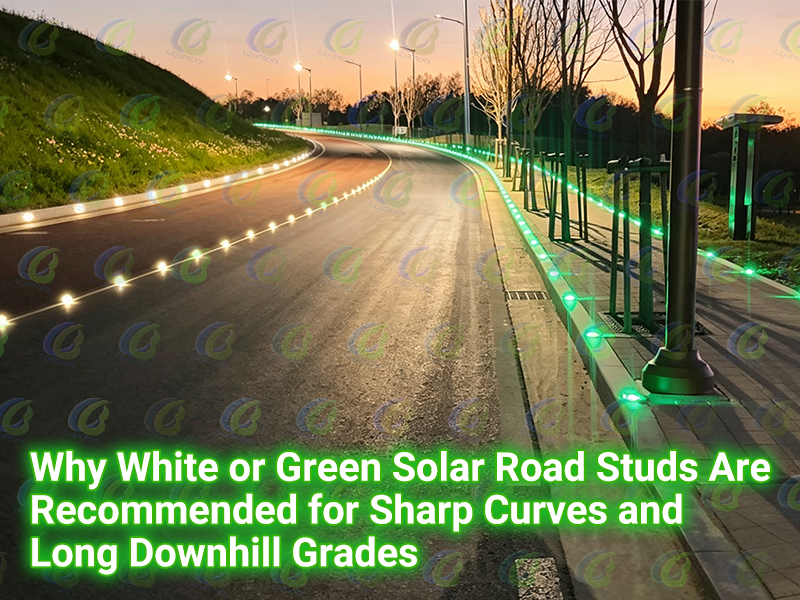
Roadway Delineation: Why White or Green Solar Road Studs Are Recommended for Sharp Curves and Long Downhill Grades
In the daily planning of road safety engineering and traffic infrastructure, a common design instinct often arises: since red signals absolute danger, should we install large numbers of red solar road studs on high-risk sections to attract driver attention? It's a very understandable thought.
However, when we look at the actual feedback from road safety engineering and driver visual psychology, the choice of light color involves deeper, more systematic considerations. In different scenarios, letting different light colors perform their designated roles leads to the best possible roadway visibility and safety.
I. Comparing the Four Core Light Colors in Road Safety Lighting
In traffic guidance applications, the visual efficiency and user experience of different light colors vary significantly. Here are the characteristics of the four most common light colors used in solar road studs:
- Cool White Light: Offers the highest brightness and sharpness, providing excellent contrast and remote visibility. However, in heavy fog or rain, white light can create “veiling glare” for drivers due to light scattering.
- Green Light: Under low nighttime illumination, its wavelength aligns with the eye's scotopic sensitivity zone. In rainy or foggy conditions, green light provides exceptional contrast and is less prone to veiling glare, making it an extremely effective visual warning.
- Amber (Yellow) Light: Provides a softer, penetrating beam often used for standard lane markings or landscape guidance. Amber light causes the least visual fatigue, making it suitable for long driving stretches.
- Red Light: Has strong focusing ability and minimal background interference. In traffic engineering, red is strictly defined as the highest level of crisis intervention or prohibition signal, giving it an irreplaceable level of urgency.
II. Precise Color Matching for High-Risk Applications
Just as highways and city roads typically use clear cool white and amber light for lane separation, color selection for solar raised pavement markers on mountain roads must be tailored to specific road conditions and environmental characteristics.
1. Sharp Curves on Mountain Roads
On roads with continuous sharp curves, the two main nighttime driving hazards are large blind spots for drivers and the slow capture of the road's alignment.
Light Color Challenge: In the darkness of night, the eye's sensitivity to red light decreases significantly, while it becomes most sensitive to short-wavelength white and green light. Data suggests that under equal power consumption, the perceived brightness of white and green light is significantly higher than that of red light. If red is used extensively on curves, it can appear blurry at long range, failing to define a continuous road outline in time.
Engineering Application: We fine-tune our approach based on the project's weather characteristics. For standard dry curves, we prioritize cool white light for maximum visibility. For mountain roads that are frequently rainy or foggy, we recommend green light solutions (including bi-color customization), as green provides superior color contrast and is less susceptible to glare interference. Regardless of whether the project requires embedded or raised studs, or aluminum or polymer materials, we ensure guidance light is focused precisely within the driver's field of view at distances up to 300 meters.
2. Long Downhill Grade Projects
On continuous long downhill sections, heavy trucks travel long distances over relatively uniform road alignment. Finding the right lighting configuration to reduce rear-end collision rates is a key concern.
Light Color Challenge: If a long downhill stretch is lined with high-frequency flashing red studs, a driver's brain can easily develop visual numbness. If a vehicle ahead suddenly breaks down with red hazard lights, a driver overexposed to red may fail to respond instantly, increasing the risk of rear-end collisions and creating potential liability for contractors.
Engineering Application: Using flexible light color and operating mode combinations (including steady, flashing, and synchronized flashing) is now common practice. Under low light, white or amber light creates a clear, gentle, and continuous guidance track on the downhill surface, reducing driver fatigue while providing clear direction. More importantly, this standard color division allows white or amber light to handle routine guidance, while reserving the most critical “red warning” for vehicle brake lights, significantly reducing accident rates on these sections.
III. Conclusion and Discussion
Selecting a road safety marker isn't an intuitive black-and-white decision. It requires a systematic approach tailored to specific road and climate conditions, letting each color play its part.
As manufacturers with over 15 years of experience in the traffic facility sector, we offer a comprehensive lineup of solar road studs with customizable single/double-sided illumination and a wide range of colors. If you're currently planning or selecting products for a sharp curve or long downhill project, we invite you to get in touch. Our team can provide practical recommendations and technical support based on your specific road conditions and lighting requirements. We look forward to discussing your project with you.
Why Wired LED Road Studs Are Ideal for Highway and Tunnel Applications?
Choosing the Right Warm White Color Temperature for Solar Road Studs
Related Article