

Radar Speed Signs: 2025 Global Market Analysis & 2026 Outlook
Radar Speed Signs: 2025 Global Market Analysis & 2026 Outlook
1. Global Market Size
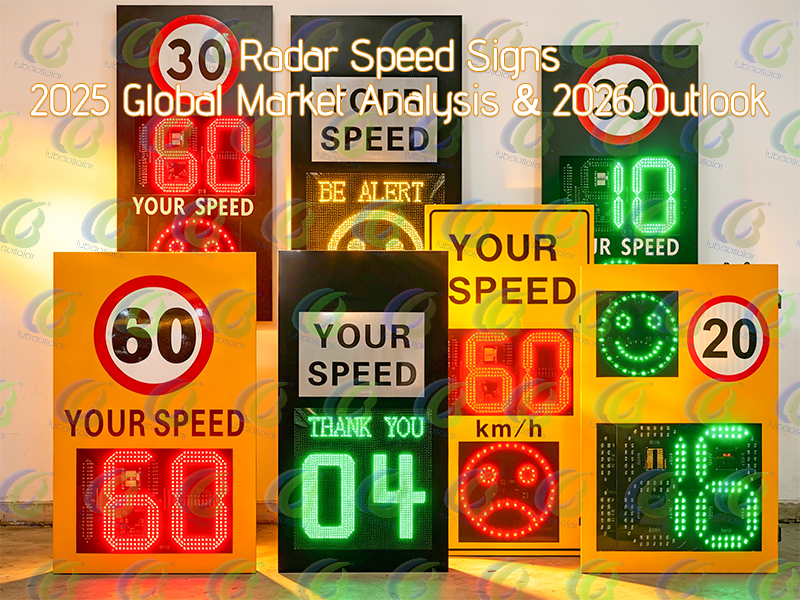
According to QYResearch and other sources, the global radar speed sign market was approximately US$230 million in 2025. Radar speed signs (also known as driver feedback signs), as active traffic safety devices, have proven highly effective in reducing motor vehicle speeds.
2. Demand Structure & Regional Distribution
Procurement entities fall into three main categories: government transportation departments (bulk tenders), schools & communities (policy-driven), and construction companies & mining firms (preference for portable solutions).
By region, North America and Europe are mature markets, where demand is driven by replacement of aging units and networked upgrades. Asia-Pacific, the Middle East, and Africa are growth markets with large numbers of new deployments, showing a clear preference for solar-powered products. In the Asia-Pacific region especially, solar radar speed signs have become the preferred choice for new road projects because they do not require grid connection.
3. Application Scenarios
- Highways: Largest market share (~50%), but has entered a stable phase.
- School zones: Benefiting from policy priority on child safety. Speed reduction of approx. 38% was observed in a South Australian pilot (average speed reduction of 4.1–8.3 km/h; serious injury crash risk reduction of 5%–43%).
- Work zones: Driven by stricter road construction safety regulations, growing faster than the market average.
- Urban roads: Demand boosted by smart city initiatives and traffic calming policies.
4. Quality Assessment & Certification Frameworks
Core quality indicators:
Radar speed accuracy: Industry standard for fixed units is ±1 km/h; for portable units, ±2 km/h.
LED display: IP67 ingress protection is a common requirement.
Power system: High-end products support more than 15 days of continuous cloudy/rainy weather operation.
| Level | Certification/Standard | Applicable Markets & Explanation |
|---|---|---|
| Basic market access | FCC / CE / RoHS / IP67 | North America, EU – electrical safety, EMC, environmental compliance, ingress protection. |
| Basic market access | MUTCD (US) | Mandatory for US market – defines sign color, brightness, flash pattern, etc. |
| Competitive differentiation | EN 12966 (EU) | Certification by TÜV or similar proving optical performance (luminance, viewing angle, durability) beyond basic requirements; common in high-end European tenders. |
| Competitive differentiation | NEMA TS 4 (North America) | High environmental reliability requirements for vibration, temperature/humidity cycling, etc. |
| Supplier qualification | ISO 9001 (QMS) | Not a product performance certification, but often required for suppliers in large international tenders. |
5. Product Forms: Fixed vs. Portable
For both fixed and portable units, the power supply solution directly affects deployment cost and maintenance frequency. In terms of power supply, solar-powered radar speed signs accounted for 59.4% of the global market. Among portable products, about 41% are solar-powered, and this share grew 38% year-over-year.
Fixed
Installed on roadside poles or gantries, used for long-term speed warning on highways, school zones, urban roads. Technology trends include integrating cellular communication modules (4G/5G) for remote data backhaul and device status monitoring, evolving from a simple warning terminal into a roadside sensing node.
Portable / Trailer-mounted
Built on a trailer chassis, integrating radar, LED display, and solar power system. Can be quickly deployed in work zones, temporary event security, police speed enforcement, etc. No trenching or wiring required; solar plus battery supports maintenance‑free mobility.
The global portable radar speed sign market was approximately US$81.05 million in 2025 and is expected to reach US$104 million by 2032, at a CAGR of about 3.7% (QYResearch).
6. 2026 Outlook
- Connectivity expansion: Cellular module costs continue to decline, increasing the share of remote data transmission and O&M functions. Over 42% of urban traffic management systems already integrate radar data into smart city frameworks. In the next three years, radar speed signs with cellular connectivity will become an important component of smart transportation infrastructure.
- Supply chain adjustments: Due to trade policy changes such as US additional tariffs on China, international buyers are diversifying sourcing channels. Suppliers holding multiple target-market certifications while maintaining cost competitiveness will benefit.
- Rising weight of services: In international tender scoring, warranty period, spare parts network, and overseas technical support response time are becoming increasingly important.
From "Visible" to "Audible": How the LB-S10 Redefines School Bus Stop Sign Safety
2025 Heliport Lighting Market Analysis and 2026 Outlook
Related Article