
How to Choose a Mobile Light Tower for Construction and Mining Projects
How to Choose a Mobile Light Tower for Construction and Mining Projects
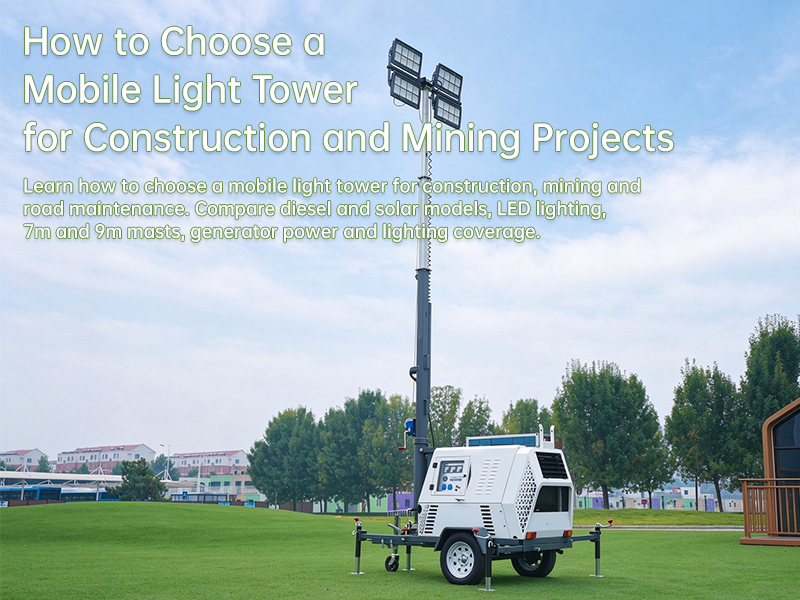
Reliable lighting is essential for construction sites, mining operations, road maintenance and other outdoor projects that continue after dark. In remote areas without access to a stable power supply, a mobile light tower provides a practical solution for temporary outdoor lighting.
However, choosing the right mobile light tower involves more than comparing lamp wattage. Buyers also need to consider lighting coverage, mast height, generator capacity, fuel consumption, transportation requirements and the working environment.
For contractors, equipment rental companies and project procurement teams, selecting the right configuration can help improve work efficiency while avoiding unnecessary operating costs.
In this guide, LUBAO explains the key factors to consider when choosing a diesel or solar mobile light tower, with practical specifications and model references to help you make an informed purchasing decision.
Table of Contents
- Where Are Mobile Light Towers Used?
- LED vs Metal Halide Light Towers: Which Is Better?
- How Much Area Can a Mobile Light Tower Illuminate?
- 7m vs 9m Mobile Light Tower: What Is the Difference?
- How to Choose Generator Power and Fuel Tank Capacity
- Diesel vs Solar Mobile Light Towers
- How to Choose a Light Tower for Different Applications
- LUBAO Mobile Light Tower Models and Specifications
- What Should You Check Before Buying a Mobile Light Tower?
- Frequently Asked Questions
1. Where Are Mobile Light Towers Used?
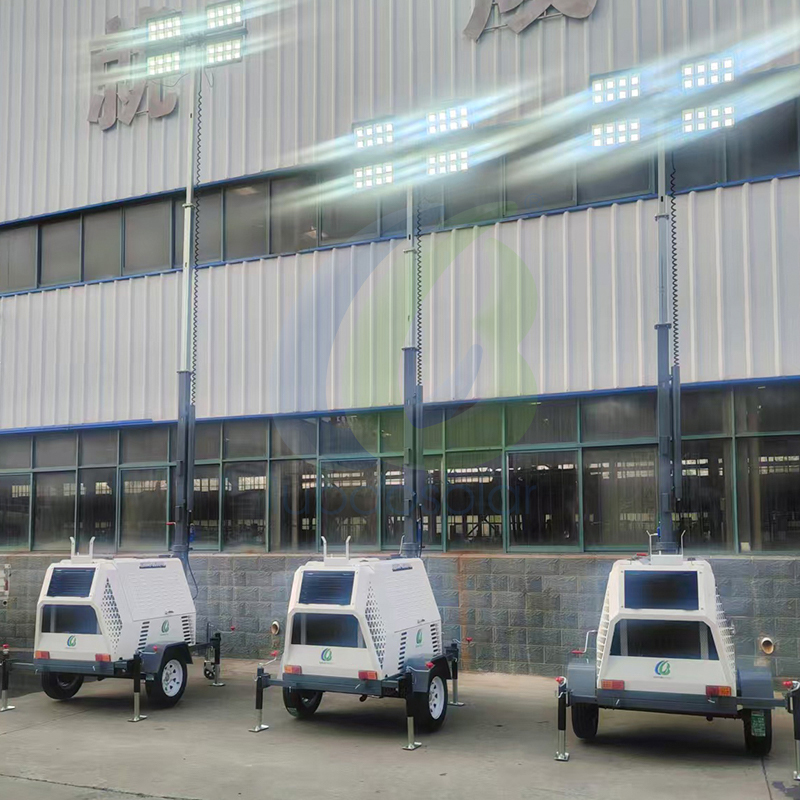
A mobile light tower is a portable lighting system generally equipped with a trailer-mounted chassis, an adjustable mast and multiple lighting fixtures. Depending on the model, it can use a diesel generator, gasoline generator or solar power system.
Its mobility and independent power supply make it suitable for outdoor projects where permanent lighting infrastructure is unavailable or impractical.
Common applications include:
- Construction Sites: Providing temporary lighting for nighttime construction, equipment installation, concrete work and general site operations.
- Mining Operations: Illuminating outdoor working areas, temporary mining facilities and equipment maintenance locations.
- Road Maintenance: Supporting nighttime road repairs, bridge maintenance and temporary traffic construction zones.
- Infrastructure Projects: Providing lighting for remote roadworks, utility maintenance and outdoor engineering projects.
- Emergency Operations: Supporting temporary lighting requirements during power outages and emergency repair work.
For projects involving frequent relocation, buyers should pay attention to trailer dimensions, transportation convenience and mast operation. For long-term applications, lighting performance, power supply and maintenance requirements are equally important.

2. LED vs Metal Halide Light Towers: Which Is Better?
The lighting system directly affects power consumption, operating costs and illumination performance. LED and metal halide lights are two common options for mobile light towers.
LED Light Towers
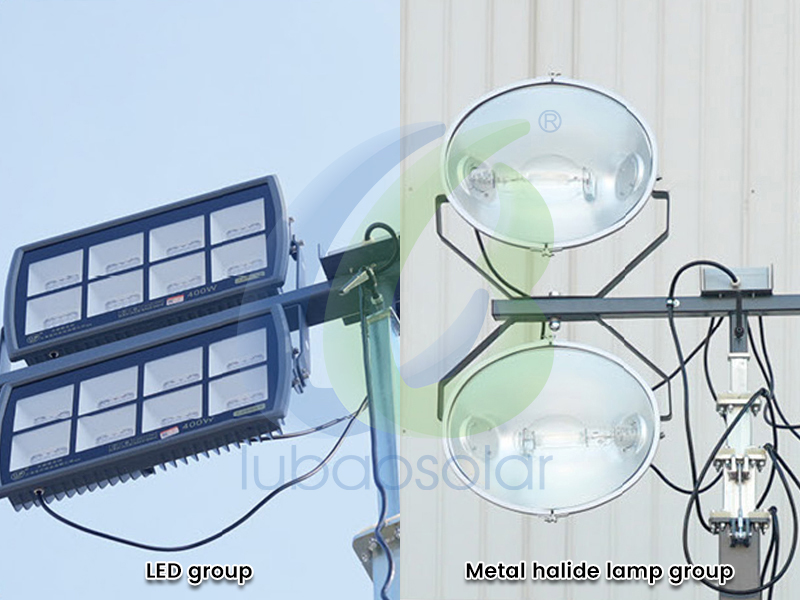
LED lighting is widely used in modern mobile lighting equipment because of its relatively low energy consumption, long service life and instant start-up.
For projects requiring extended operating hours, LED lighting can help reduce the electrical load on the generator compared with higher-wattage traditional lighting configurations.
For example, the LUBAO 090 mobile light tower can be equipped with four 400W LED lights, providing a total rated lighting power of 1,600W.
This configuration is suitable for road maintenance, construction sites and temporary outdoor work areas.
Metal Halide Light Towers
Metal halide lighting remains an option for projects that already use traditional lighting equipment or have specific lighting configuration requirements.
LUBAO mobile light tower models can be equipped with metal halide light arrays. Depending on the model, available configurations include two or four 1,000W metal halide lamps.
When selecting this option, buyers should consider the total lamp power, generator capacity, starting requirements and operating costs.
Which Lighting Type Should You Choose?
- Choose LED lighting if energy efficiency and long-term operating costs are important considerations.
- Consider metal halide lighting if the project has specific requirements for traditional lighting systems.
- Always check whether the generator capacity matches the selected lighting configuration.
The best choice depends on the project's lighting requirements and operating conditions rather than lamp wattage alone.
3. How Much Area Can a Mobile Light Tower Illuminate?
Lighting coverage is one of the most important factors when purchasing a mobile light tower. However, the illuminated area cannot be determined by lamp wattage alone.
Taking the LUBAO 090 mobile light tower with four 400W LED lights as an example, its reference lighting coverage is approximately 4,000–5,000 square meters.
The actual lighting performance depends on several factors:
- Mast lifting height
- LED light output and beam angle
- Light fixture orientation and adjustment
- Buildings, machinery and other obstacles
- Required ground illumination levels
For example, a road maintenance project may require concentrated lighting along a specific working area, while a large construction site may need broader illumination across several working zones.
Even with the same lamp power, different installation heights and lighting angles can produce different results.
Therefore, if your project requires a specific lighting area or minimum illuminance level, it is recommended to provide the site dimensions and lighting requirements before selecting a model.
4. 7m vs 9m Mobile Light Tower: What Is the Difference?
Mast height affects the position of the lighting fixtures and the distribution of light across the working area.
A higher mast can help distribute light over a wider area, although the final result also depends on the lighting design and site conditions.
7m Mobile Light Tower
The LUBAO 7m mobile light tower features a seven-section manual winch mast with an adjustable lifting height of approximately 2.5–7 meters.
It is suitable for projects requiring elevated lighting while maintaining a relatively compact equipment configuration.
9m Mobile Light Tower
The LUBAO 9m diesel mobile light tower uses a three-section manual winch mast with an adjustable height of approximately 4.6–9 meters.
The higher mounting position can help distribute lighting over a larger working area, making it suitable for selected large construction sites and outdoor projects.
7m vs 9m Light Tower Comparison
| Specification | 7m Model | 9m Model |
|---|---|---|
| Mast Structure | 7-section manual winch | 3-section manual winch |
| Mast Height | 2.5–7m | 4.6–9m |
| Main Consideration | Medium-height lighting | Higher-position lighting |
A higher mast is not always the best solution. Wind conditions, equipment stability, lighting direction and actual working requirements should also be considered.
5. How to Choose Generator Power and Fuel Tank Capacity
For a diesel mobile light tower, the generator must provide sufficient power for the lighting system and any additional electrical loads required by the project.
LUBAO offers different generator configurations depending on the mobile light tower model.
Examples include:
- 9m Diesel Mobile Light Tower: Optional water-cooled, three-cylinder diesel generator rated at 9kW, 9.5kW or 11kW, with a 100L fuel tank.
- 094 Type Mobile Light Tower: 4.5kW diesel generator with a 48L external fuel tank.
- 7m Mobile Light Tower: 14.5kW diesel generator with a 48L external fuel tank.
- 090 Type Mobile Light Tower: Optional 4.5kW or 6.5kW diesel or gasoline generator, with a 12.5L fuel tank.
The diesel generator used in LUBAO's mobile light tower configurations is from Quanchai.
Generator power and fuel tank capacity vary between models and should not be considered interchangeable.
Before purchasing, buyers should confirm:
- Total power consumption of the selected lighting fixtures.
- Additional electrical loads, if any.
- Required output voltage and frequency.
- Generator capacity and operating requirements.
- Expected operating conditions and fuel supply arrangements.
For projects requiring 110V, 220V or other voltage outputs, the electrical configuration should be confirmed before production.
6. Diesel vs Solar Mobile Light Towers: Which Should You Choose?
The main difference between diesel and solar mobile light towers is their power supply system.
The right choice depends on local electricity availability, sunlight conditions, daily operating hours, fuel supply and maintenance requirements.
Diesel Mobile Light Tower
A diesel mobile light tower uses an onboard generator to supply power to the lighting fixtures.
Because it does not depend on a fixed electrical grid, it is suitable for remote construction sites, road maintenance projects and other outdoor working environments.
Main considerations:
- Independent power generation
- Flexible outdoor applications
- Fuel availability and refueling
- Engine maintenance and operating costs
Solar Mobile Light Tower
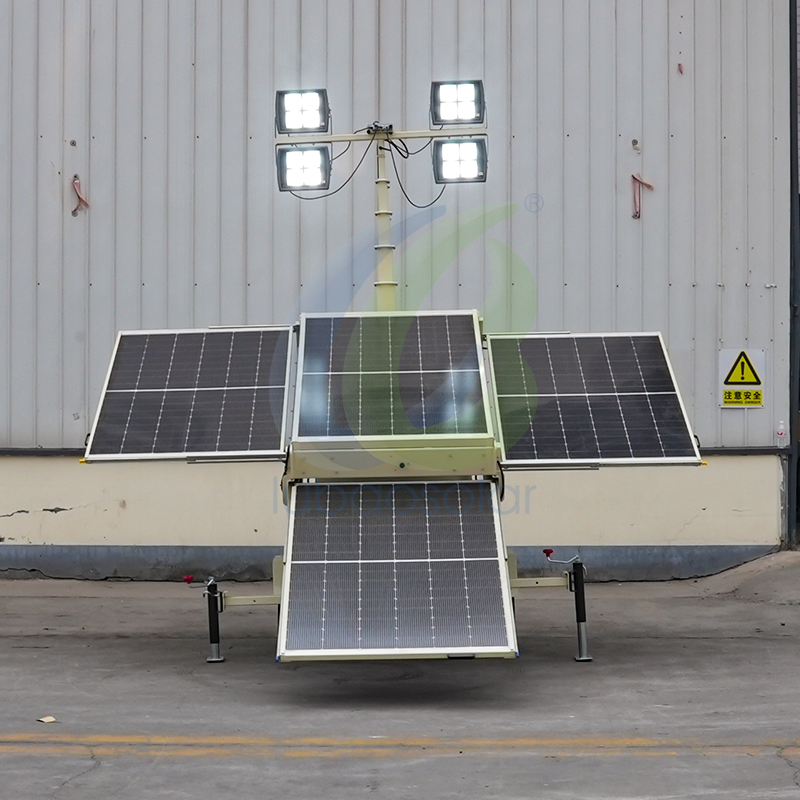
A solar mobile light tower uses photovoltaic panels to charge batteries, which then supply power to the LED lighting system.
It is suitable for outdoor projects with adequate sunlight, especially where reducing fuel consumption is an important consideration.
The LUBAO 9m solar mobile light tower features the following configuration:
| Component | Specification |
|---|---|
| Solar Panels | 4 monocrystalline panels |
| Solar Panel Power | 32V, 430W each |
| Total Solar Power | 1,720W |
| Battery | 12V, 200Ah gel maintenance-free lead-acid |
| Battery Quantity | 4 pcs |
| Lighting System | 4 LED lights |
| Light Output | 22,000 lumens per light |
| Total Light Output | 88,000 lumens |
| Mast Height | 2.5–9m |
| Mast Structure | 7-section manual winch |
| Solar Panel Adjustment | Manual telescopic slide rail |
The actual operating time depends on sunlight availability, battery condition, charging efficiency, lighting power and daily usage.
It is therefore important to evaluate the local weather and expected operating schedule rather than assuming a fixed number of operating hours.
Diesel vs Solar Mobile Light Tower Comparison
| Comparison | Diesel Model | Solar Model |
|---|---|---|
| Power Supply | Diesel generator | Solar panels and batteries |
| Energy Source | Diesel fuel | Solar energy |
| Main Requirement | Fuel supply and engine maintenance | Adequate sunlight and battery management |
| Suitable Applications | Flexible power requirements and changing work locations | Outdoor projects with suitable sunlight |
For locations with frequent cloudy weather or extended rainy seasons, the solar charging capacity should be carefully evaluated.
Where fuel supply is difficult, a solar configuration may be worth considering if the local sunlight conditions are suitable.
7. How to Choose a Light Tower for Different Applications
Different projects have different lighting requirements. The following examples illustrate how buyers can approach mobile light tower selection.
Application 1: Road Maintenance and Nighttime Construction
Road maintenance projects often require temporary lighting that can be moved as work progresses.
A compact mobile light tower can be a practical option for these applications.
For example, the LUBAO 090 model can be configured with four 400W LED lights and a diesel or gasoline generator.
The final configuration should depend on the road width, working area and required lighting height.
Application 2: Large Construction Sites
Large construction sites may have several working areas operating simultaneously.
A 9m mobile light tower can be considered when higher fixture installation is needed to distribute light across a wider outdoor area.
For locations without a stable electrical supply, a diesel generator configuration provides an independent source of power.
The generator rating should be selected according to the total lighting load and any additional power requirements.
Application 3: Remote Mining and Outdoor Operations
Remote mining projects may have limited access to permanent electricity infrastructure. Fuel transportation and equipment maintenance can also affect operating costs.
If the project has sufficient sunlight, a solar mobile light tower may be considered.
If flexible power generation is more important and fuel is readily available, a diesel model may be more suitable.
For mining applications, buyers should also check whether the equipment meets site-specific requirements for protection, fuel containment, emergency stop systems, electrical safety and other applicable regulations.
A standard outdoor mobile light tower should not automatically be considered compliant with mine-specific safety requirements.
Practical selection note: These are representative application scenarios rather than claims about specific customer installations. Actual equipment selection should be based on the project conditions and technical requirements.
8. LUBAO Mobile Light Tower Models and Specifications
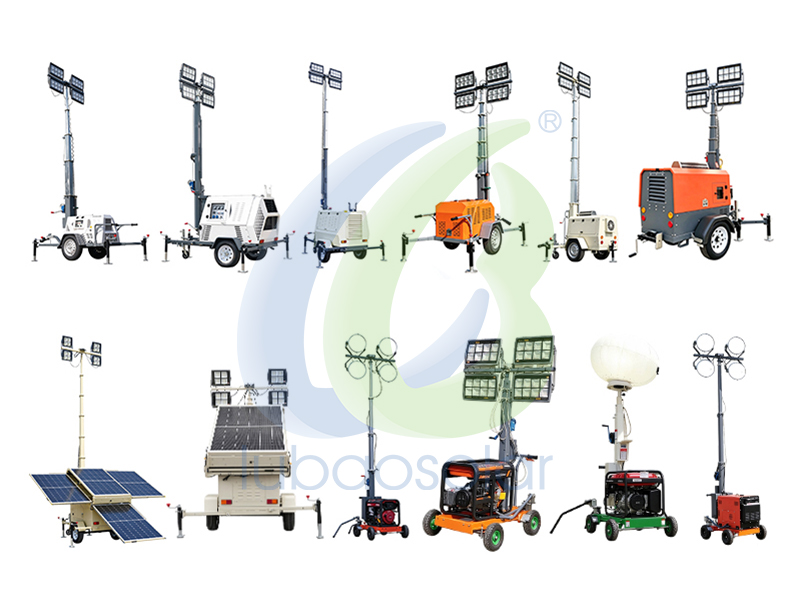
LUBAO provides several trailer-mounted mobile light tower configurations for outdoor construction, road maintenance and other temporary lighting applications.
Different models offer different mast heights, generator capacities, lighting configurations and chassis dimensions.
| Model | Mast Height | Main Configuration | Typical Application |
|---|---|---|---|
| 9m Diesel Model | 4.6–9m | 9/9.5/11kW generator options, 100L fuel tank | Large outdoor construction and temporary lighting |
| 9m Solar Model | 2.5–9m | 1,720W solar panels, 4 × 12V 200Ah batteries | Outdoor and remote-area lighting |
| 095 Type | Up to 9m | 9/9.5/11kW generator options, 100L fuel tank | Construction and outdoor lighting |
| 094 Type | 2.5–7m | 4.5kW diesel generator, 48L external fuel tank | Medium and small construction projects |
| 090 Type | 1.8–5m | 4.5/6.5kW generator options, 12.5L fuel tank | Road maintenance and temporary work |
| 7m Model | 2.5–7m | 14.5kW diesel generator, 48L external fuel tank | Outdoor construction and higher-power lighting |
The above specifications are general references. Lighting fixtures, generator configurations and certain structural details may vary according to the selected model.
For detailed product selection, buyers should confirm the final technical specifications before placing an order.
9. What Should You Check Before Buying a Mobile Light Tower?
For bulk purchases and engineering projects, confirming the technical requirements in advance can help prevent problems such as insufficient lighting coverage, incompatible power configurations and transportation difficulties.
Before requesting a quotation, it is recommended to prepare the following information:
- Application: Construction, mining, road maintenance or another outdoor project?
- Lighting Coverage: How large is the area that needs to be illuminated? Is there a minimum illuminance requirement?
- Lighting Configuration: LED or metal halide? How many lamps are required?
- Mast Height: Is a 7m or 9m mast required?
- Power Supply: Diesel generator or solar power system?
- Electrical Requirements: What output voltage and frequency are needed?
- Working Environment: Will the equipment operate in high temperatures, strong winds, dusty conditions or heavy rain?
- Transportation: Will the equipment be transported by trailer, container or another method?
For bulk orders and project procurement, it is also helpful to provide the destination market, estimated order quantity and any special technical requirements.
This information allows the supplier to recommend a more suitable mobile light tower configuration.
10. Frequently Asked Questions About Mobile Light Towers
1. How much area can a mobile light tower illuminate?
Lighting coverage depends on lamp power, beam angle, mast height and site conditions.
For example, the LUBAO 090 mobile light tower equipped with four 400W LED lights has a reference lighting coverage of approximately 4,000–5,000 square meters.
Actual performance should be evaluated according to the required ground illuminance and project layout.
2. Can a diesel mobile light tower operate without grid electricity?
Yes. A diesel mobile light tower uses its onboard generator to supply electricity to the lighting fixtures. It does not require a fixed electrical grid, although regular fuel supply and engine maintenance are necessary.
3. How many hours can a solar mobile light tower operate?
Operating time depends on battery capacity, sunlight availability, charging conditions, LED power consumption and daily usage.
A reliable operating-time estimate requires evaluation of the complete solar and battery configuration.
4. Can mobile light towers be customized?
Different configurations can be evaluated according to project requirements, including lighting type, mast height, generator power, output voltage and other equipment options.
The available customization options depend on the selected model and technical requirements.
5. Can standard mobile light towers be used in mining projects?
Not necessarily. Mining environments may require additional equipment protection, fuel containment, emergency stop systems and electrical safety compliance.
Buyers should provide the applicable site standards and technical requirements before ordering to confirm whether the selected equipment is suitable.
Conclusion
Choosing the right mobile light tower is not simply about selecting the highest wattage or tallest mast. The key is to match the lighting system, power supply and equipment configuration to the actual working environment.
From diesel-powered lighting for remote construction sites to solar mobile light towers for outdoor applications, each project requires a different approach to equipment selection.
By considering lighting coverage, mast height, generator capacity and operating conditions, buyers can make more practical purchasing decisions.
LUBAO offers various mobile light tower models and configuration options for construction, road maintenance, mining and infrastructure projects.
If you are sourcing mobile light towers for a project or bulk purchase, contact LUBAO with your application requirements. Our team can help you evaluate suitable models and equipment configurations.
Contact LUBAO Smart Traffic Co., Limited
Company: LUBAO Smart Traffic Co., Limited
Email: yiloca@lu-bao.com
Website: www.lu-bao.com
Contact us for mobile light tower specifications, product configurations and project-based quotations. We welcome inquiries from distributors, equipment rental companies, contractors and project procurement teams.
What Is an Airport Wind Sock? How to Choose an Illuminated Wind Indicator
Related Article