
EN 1463-3 and ASTM D4280 Standards: Key Certifications for Solar Road Stud Selection
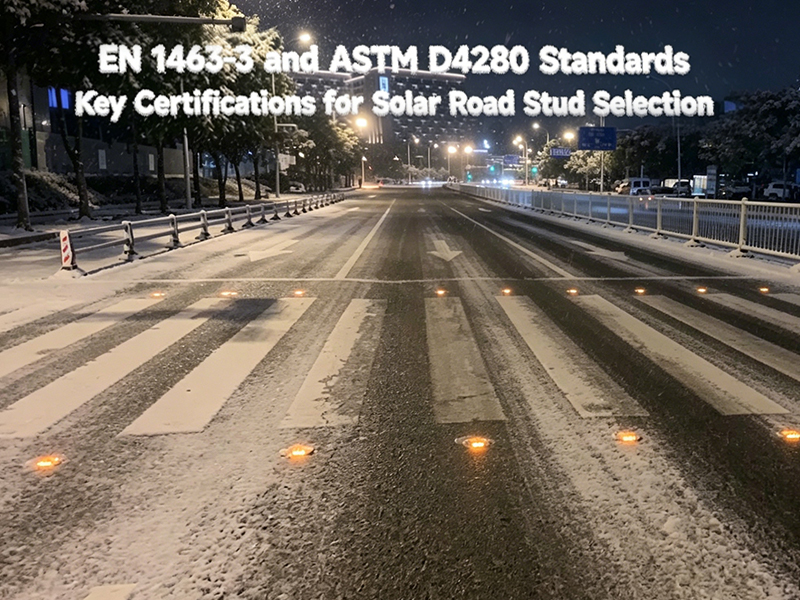
EN 1463-3 and ASTM D4280 Standards: Key Certifications for Solar Road Stud Selection
Accidents on rainy nights are significantly more frequent than on dry nights, and wet-condition reflectivity is a critical factor for road safety. The most direct way to assess road stud performance is to check which standards they meet, especially EN 1463-3 and ASTM D4280.
Testing Focus
| Standard | Key Focus | Practical Implication |
|---|---|---|
| EN 1463-3 | Wet reflectivity, post-wear reflectivity | Night visibility in rain, consistent performance over lifespan |
| ASTM D4280 | Impact resistance, static load capacity, LED stability | Structural integrity under heavy vehicle traffic |
✅ These two standards focus on different aspects but complement each other.
✅ Road studs that pass both certifications achieve high optical performance and physical strength.
Common Failure Points in Testing
- ⚠️ EN 1463-3 / Wet reflectivity: Most failures occur in wet reflectivity tests. Many studs perform well in dry conditions, but reflectivity may drop sharply when covered with water.
- ⚠️ ASTM D4280 / Impact & load: Static load and temperature cycling are common failure points. The 20-ton static load requirement demands strong housing, while -40°C to +80°C temperature cycling tests the precision of aluminum-polycarbonate assembly.
Industry Trends and Standard Evolution
- 🌧 Greater emphasis on wet reflectivity: EN 1463 series strengthens wet-condition testing to reduce rainy night accidents.
- 💡 Enhanced active LED standards: ASTM D4280 now includes LED requirements; more regions require electromagnetic compatibility (FCC, IC).
- 🕒 Higher durability requirements: Focus has shifted from “factory compliance” to “performance after several years of use,” with buyers increasingly requesting accelerated aging reports.
LS-68A solar road studs fully comply with these standards, combining high reflectivity, heavy load resistance, and eco-friendly solar power to ensure reliable road safety.
How LS-68A Addresses Common Issues
| Common Issue | LS-68A Design Solution |
|---|---|
| Poor visibility on rainy nights | Passed EN 1463-3 wet reflectivity test, maintaining clear night visibility |
| Cracking or lifting under heavy vehicles | Meets ASTM D4280 impact and static load requirements, supporting up to 20 tons |
| Cracking in winter or softening in summer | Operating temperature -40°C to +80°C, passed temperature cycling tests |
| External power wiring challenges | Solar-powered, no wiring required, eco-friendly, continuous night illumination |
LS-68A Key Specifications
| Feature | Specification |
|---|---|
| Housing | High-strength aluminum + polycarbonate |
| Protection Rating | IP68 |
| Maximum Load | 20 tons |
| Operating Temperature | -40°C ~ +80°C |
| LED Colors | White / Yellow / Red / Blue |
| Power Type | Solar charging |
| Certifications | EN 1463-3, ASTM D4280, FCC, IC |
Conclusion
EN 1463-3 and ASTM D4280 ensure road stud performance in optical and physical aspects. LS-68A solar road studs are designed to handle wet-night reflectivity, heavy vehicle pressure, extreme temperatures, and installation limitations, providing long-term road safety while being eco-friendly and energy-efficient.

For product specifications and quotations, please feel free to contact us.
Solar Road Stud 2025 Market Analysis Brief & 2026 Trend Outlook
Why Europe Relies on Road Marking and Road Stud Systems in Winter
Related Article