
Which Road Stud is Best for Your Project? Solar Aluminum vs. Stainless Steel vs. Plastic vs. Glass
Which Road Stud is Best for Your Project? Solar Aluminum vs. Stainless Steel vs. Plastic vs. Glass
Choosing the wrong road stud can lead to a maintenance bill three years later that far exceeds your initial procurement budget.
In traffic safety engineering, the core of selecting raised pavement markers (RPMs) lies in a precise balance between initial procurement costs (CapEx) and total lifecycle maintenance costs (OpEx). Mistakes in selection can lead to frequent equipment damage, mounting citizen complaints, or even fatal traffic accidents due to a sudden loss of nighttime visibility.
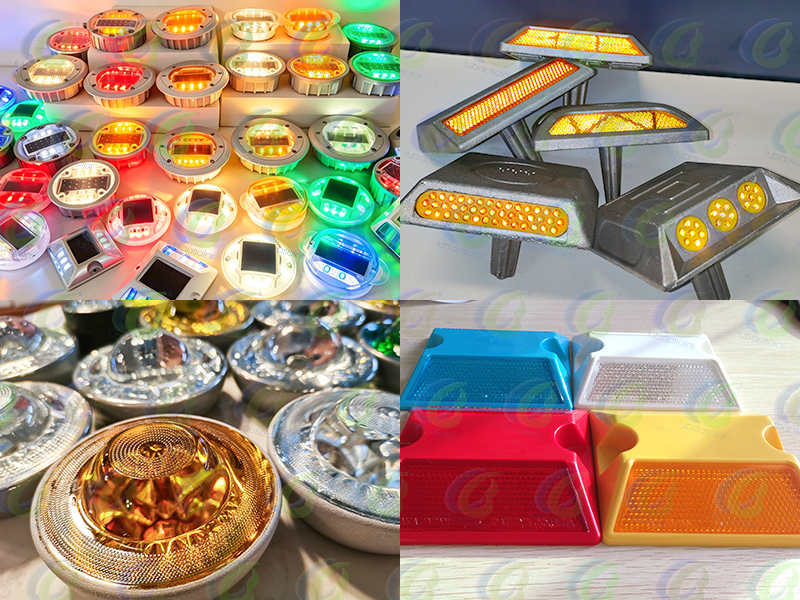
How can you avoid these engineering risks? Based on the EN 1463-1 standard, this guide evaluates four mainstream road studs (road cats eyes), clearly defining their application boundaries and potential hidden risks.
📊 Comprehensive Road Studs Comparison Matrix
| Product Type | Initial Cost (CapEx) | Maintenance Cost (OpEx) | Load Capacity (EN 1463-1) | Effective Visibility | Main Engineering Limitations |
|---|---|---|---|---|---|
| Solar Aluminum | Medium-High | Low | 30 - 40 Tons | >500m (Active LED) | Low sun in winter at high latitudes |
| Solar Stainless Steel | High | Ultra-Low | 40 - 60 Tons | >400m (Active LED) | Heavy weight, high shipping costs |
| Traditional Plastic | Ultra-Low | High | 10 - 15 Tons | 150m (Passive Retroreflective) | UV aging, brittle under heavy trucks |
| Solid Glass | Medium | Low | 40 - 50 Tons | 200m (Passive Retroreflective) | Requires specialized snowplowable kits |
Note: The load capacity and compressive strength data above are based on standard EN 1463-1 testing conditions.
🔍 Road Stud Selection Guide
1. Aluminum Solar Road Studs
- The Technology: Powered by built-in ultra-bright LEDs (Active LED Emission), providing over 500 meters of visibility in heavy rain, snow, or dense fog.
- Engineering Advantages: Excellent high-temperature resistance. For hot desert environments (e.g., Middle East or Australia), the energy storage can be customized with supercapacitors instead of lithium batteries, raising temperature tolerance to 80°C and extending service life up to 10 years.
- Best Applications: Highway centerlines, accident-prone sharp curves, and foggy rural roads without streetlights.
- Potential Risks: In high-latitude regions with severe winter sun deficits, charging efficiency drops. Forcing solar studs into these deep-shade zones can lead to battery drain and nighttime failure.
2. Stainless Steel Solar Road Studs
- The Technology: Formed through an integrated molding of heavy-duty 304 or 316 stainless steel, offering an ultimate compressive strength of 40–60 tons.
- Engineering Advantages: Built to withstand high-frequency tire impact from heavy vehicles. It features premium corrosion resistance against marine salt spray and acid rain.
- Best Applications: Heavy-duty freight docks, smart pedestrian crosswalk borders, and high-end urban landmark projects.
- Potential Risks: It carries the highest unit cost. Its massive physical weight drastically increases ocean and inland freight costs, meaning large-scale deployment will severely strain a standard highway budget.
3. Traditional Plastic Road Markers (ABS/PC)
- The Technology: Uses lightweight engineering plastics (ABS or Polycarbonate) combined with standard micro-prismatic reflective sheeting for passive retroreflection.
- Engineering Advantages: Extremely low initial cost. It is highly lightweight, reduces epoxy consumption during installation, and shortens construction hours. It remains the top volume seller in the wholesale road studs market.
- Best Applications: Indoor underground parking lots, closed residential communities, and temporary construction detours.
- Potential Risks: Long-term UV exposure degrades the plastic matrix, making the housing brittle and fading the lenses. When installed on high-speed heavy traffic lanes, fracturing and detachment happen quickly, creating maintenance costs that erase any initial savings.
4. Solid Glass Road Studs (Reflective Glass Cats Eyes)
- The Technology: Features a solid tempered glass sphere providing 360° omnidirectional retroreflection by bouncing back vehicle headlights from any angle.
- Engineering Advantages: Superior surface hardness eliminates tire scratch worries. It boasts an excellent self-cleaning effect, where daily rainfall easily washes away surface dust and silt from its smooth finish.
- Best Applications: Non-snowing urban arterials, humid coastal roads, and high-rainfall highway edges.
- Potential Risks: On routes utilizing heavy mechanical steel snowplows, the exposed glass dome will shatter under direct plow strikes unless paired with specialized recessed metal castings or snowplowable armor kits.
🛠️ Commercial Customization & Engineering Support
As an established manufacturer with over 15 years of international road safety experience (15+ Years OEM/ODM Factory), we design traffic products tailored to your project's specific climate, axle load rating, and local DOT specifications.
Our Solar Road Stud series has successfully passed FCC, IC, CE, RoHS, and ASTM D4280 certifications, fully complying with international market entry requirements. We offer flexible adjustments for flat-bottom layouts, varying anchor shank lengths, and specified 3M reflective tape grades.
Preparing a highway tender or an urgent material RFQ?
Please forward your project technical specifications and bill of quantities directly to our engineering team at: info@lu-bao.com. We will provide an aligned compliance matrix and factory-direct wholesale pricing within 24 hours.
How Do LS-09 Solar Road Studs Perform in Extreme Weather Conditions?
Smart Crosswalk Upgrades: Why Wired Synchronous Systems Are Replacing Solar Road Studs
Related Article