

Smart Crosswalk Upgrades: Why Wired Synchronous Systems Are Replacing Solar Road Studs
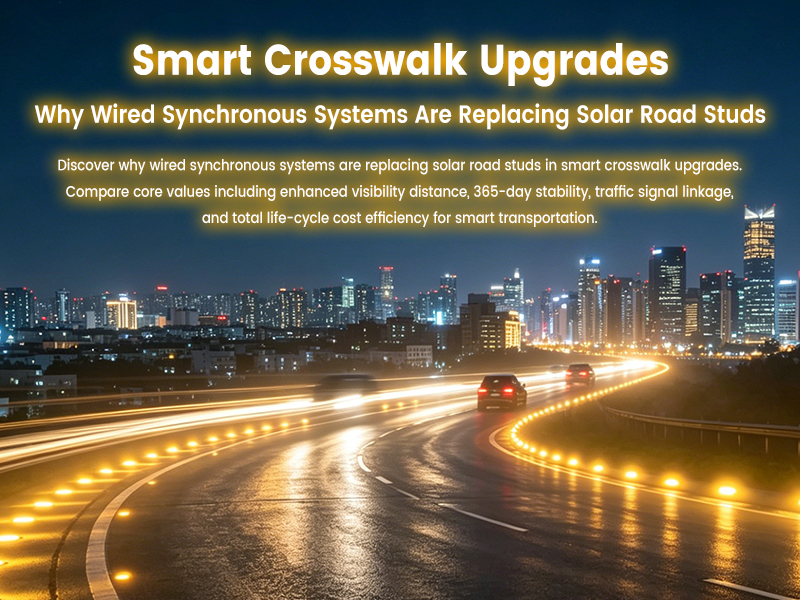
Smart Crosswalk Upgrades: Why Wired Synchronous Systems Are Replacing Solar Road Studs
Pedestrian crossing accidents rise sharply under low-visibility conditions, such as at night or during heavy rain. Traditional reflective pavement markings rely entirely on vehicle headlights. When drivers face glare, poor street lighting, or blind spots, they often lack the necessary visibility distance to react and brake safely.
To solve this root problem, global smart transportation projects are shifting from "passive reflection" to "active illumination" systems. At the execution level, pure solar-powered wireless road studs are steadily being replaced by wired synchronous solutions. This transition is more than a hardware swap; it is a systematic engineering upgrade that integrates perception, control, and execution. The reliability of the execution units directly determines the warning effectiveness of the entire system.
The core execution components of this solution are highly reliable wired synchronous road studs. Taking the LS-68A as an example:
- Material: Die-cast aluminum + PC shell
- Power Supply: DC 12V/24V safe low voltage
- Ingress Protection: IP68
- Load Capacity: Static resistance ≥ 50 tons
- Certifications: CE, RoHS, FCC, ASTM D4280, EN1463-3
Based on these technical specifications, the solution delivers distinct advantages in real-world applications:
Key Application Values of the Wired Synchronous Solution
1. Significantly Enhanced Visibility Distance
The LS-68A achieves millisecond-level linkage response, triggering synchronous flashing the instant a pedestrian steps onto the crosswalk. The synchronized visual barrier formed at a distance gives drivers significantly more time to recognize the hazard and react safely.
2. Guaranteed Year-Round Stable Operation
Unlike solar products that depend strictly on sunlight, the wired synchronous solution utilizes an external power supply. It remains completely unaffected by continuous rainy days, high-latitude winters, or extreme cold, ensuring the road studs operate reliably 365 days a year.
3. Clear Right-of-Way Guidance
The system links in real-time with traffic signal controllers: studs flash red during a red light and switch to green during a green light. Even in low-visibility conditions, both drivers and pedestrians can clearly discern the right-of-way.
4. Reduced Long-Term Maintenance Costs
Controls and power supplies are housed externally in roadside cabinets. The road stud interiors contain only the LEDs and are fully encapsulated. Its 50-ton load capacity ensures that once deployed, equipment replacement frequency drops drastically.
Life-Cycle Cost vs. Value
Admittedly, wired synchronous solutions require a higher initial investment due to road cutting, trenching, and cabling costs. However, from a long-term operational perspective, its zero-false-alarm rate, maintenance-free cycles, and deep integration with traffic signals translate directly into lower troubleshooting expenses, fewer manual inspections, and higher intersection efficiency. Consequently, its total life-cycle ROI far exceeds that of traditional wireless solar road studs.
Request More Information
To receive the complete Smart Crosswalk Solution Manual, customized project evaluations, or price quotes, please contact our team today.
Which Road Stud is Best for Your Project? Solar Aluminum vs. Stainless Steel vs. Plastic vs. Glass
How to Choose International Standard Solar Road Studs
Related Article