

The Best Choice for Rechargeable Batteries in Solar Road Studs
author: Eng.Jose
2025-01-01
The Best Choice for Rechargeable Batteries in Solar Road Studs
Rechargeable batteries are critical components in solar road studs, powering their operation during nighttime and adverse weather conditions. Various types of batteries are used, each offering distinct advantages and limitations. Let's explore the most commonly used rechargeable batteries and determine the best choice for solar road studs.
Types of Rechargeable Batteries for Solar Road Studs
Ni-MH Battery (Nickel-Metal Hydride)
Advantages:
-
Affordable and widely available.
-
Capable of 500-600 charge-discharge cycles.
-
Improved design eliminates the "memory effect," making performance similar to lithium batteries.
-
Safe for transport and storage.
Limitations:
-
Lower capacity compared to lithium batteries of the same size.
-
Reduced efficiency in extremely cold temperatures.
Applications: Suitable for moderate climates and cost-sensitive projects.
Li-Poly Battery (Lithium Polymer)
Advantages:
-
Lightweight and available in customizable shapes and sizes.
-
Ideal for compact solar road studs where space is limited.
Limitations:
- Volume and performance can degrade under compression.
- Typically supports around 600 charge-discharge cycles.
Applications: Limited use in small-sized solar road studs due to space constraints. Not generally recommended for widespread application.
LiFePO4 Battery (Lithium Iron Phosphate)
Advantages:
- Long lifespan with over 1,000 charge-discharge cycles.
- Superior performance in both high and low-temperature environments.
- Highly stable and safe for outdoor use.
Limitations:
- Higher initial cost compared to Ni-MH batteries.
- Applications: Widely considered the best choice for solar road studs due to its durability, temperature tolerance, and efficiency.
ION Solid-State Battery
Advantages:
Advanced technology with potential for greater safety and capacity.
Limitations:Not yet widely adopted or recommended for solar road studs due to limited availability and higher costs.
The Best Choice: LiFePO4 Batteries
Among the various options, LiFePO4 batteries stand out as the optimal choice for solar road studs. Their ability to endure extreme temperatures, combined with a long cycle life of over 1,000 charges, makes them highly reliable. Although they come at a higher cost, their durability and consistent performance ensure long-term cost-effectiveness.
Conclusion
Choosing the right rechargeable battery for solar road studs depends on the application, climate, and budget. For general use and demanding environments, LiFePO4 batteries are the most reliable and efficient choice. Ni-MH batteries are suitable for budget-sensitive projects, while Li-Poly batteries are best reserved for compact designs. As battery technology evolves, the adoption of advanced solutions like ION solid-state batteries may increase in the future.
By selecting the right battery, manufacturers and planners can ensure optimal performance, safety, and longevity of solar road studs across various road applications.
Ensuring Full Waterproofing for Solar Raised Aluminum Pavement Markers
Choosing the Right Solar Road Stud for Your Needs
Related Article
Wired LED Road Studs provide stable illumination and reliable road guidance for highways, tunnels, and traffic engineering projects with durable design and reduced maintenance needs.
Why Wired LED Road Studs Are Ideal for Highway and Tunnel Applications?

Road safety manufacturer explains solar road stud color selection for sharp curves and long downhill sections. Compare white, green, amber, and red light performance under low illumination and foggy conditions. Custom solutions available.
Roadway Delineation: Why White or Green Solar Road Studs Are Recommended for Sharp Curves and Long Downhill Grades
Discover the difference between 6000K, 4000K, 3000K, and 2500K solar road stud color temperatures. Learn how to choose the best warm white solar road studs for highways, cycle lanes, pedestrian pathways, parks, and landscape lighting projects.
Choosing the Right Warm White Color Temperature for Solar Road Studs
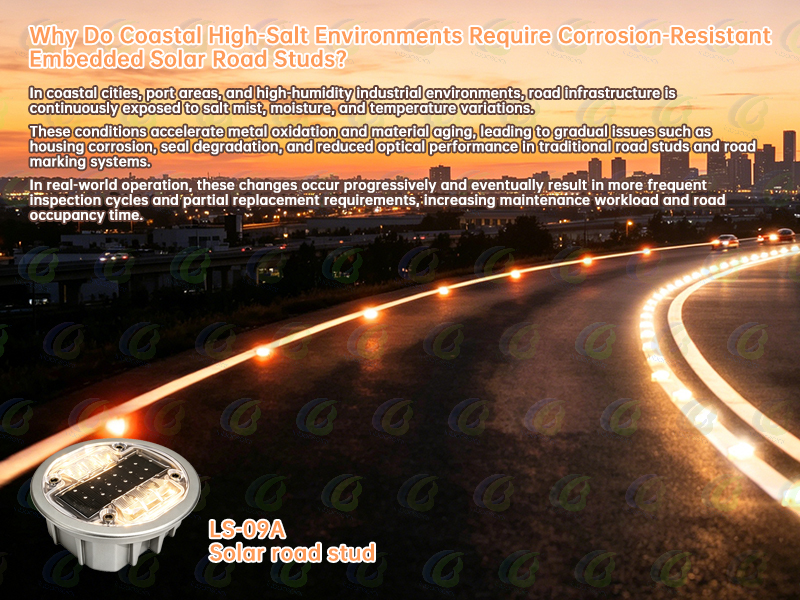
Coastal high-salt environments accelerate road infrastructure corrosion. Embedded solar road studs with corrosion-resistant materials and IP68 protection help improve night visibility and extend maintenance cycles.
Why Do Coastal High-Salt Environments Require Corrosion-Resistant Embedded Solar Road Studs?